
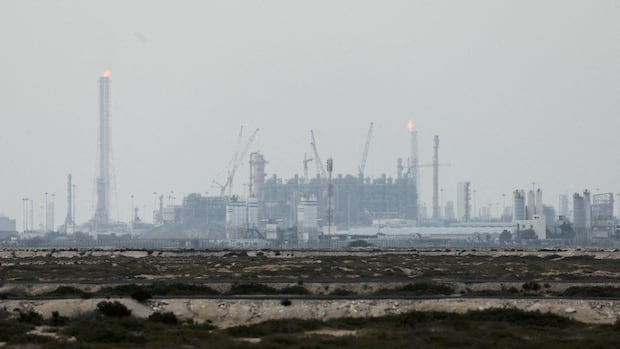
Oil and gas installations in the Persian Gulf were struck on Thursday when Israel attacked the South Pars natural gas field, a crucial energy source for Iran. This event represents a significant escalation in the ongoing conflict in the Middle East.
Following the assault on South Pars, U.S. President Donald Trump stated that Israel would refrain from further attacks on the gas field. However, he warned that if Iran continued targeting Qatar’s energy infrastructure, the U.S. would respond by severely damaging the entire field.
The attacks on oil and gas facilities in the region, combined with the closure of the Strait of Hormuz, have led to a significant reduction in global energy supply and transportation, resulting in a surge in energy prices.
News of the South Pars attack caused global oil prices to rise and Europe’s gas prices to increase, amid concerns about potential Iranian retaliation on Gulf energy infrastructure.
The South Pars natural gas field, situated in Iran, experienced heightened attacks after being targeted by Israel. This gas field, shared by Iran and Qatar, is the world’s largest natural gas reserve.
The South Pars field holds immense significance for Iran as it is the country’s primary source of domestic energy, supplying about 80% of its natural gas needs. Despite having a smaller economy, Iran ranks as the fourth-largest consumer of natural gas globally, trailing behind the U.S., China, and Russia.
In Qatar, the Ras Laffan facility, a key liquefied natural gas (LNG) export hub, faced significant damage from Iranian attacks. The assaults have disrupted Qatar’s LNG export capacity, impacting its revenue and global supply chains. The facility is crucial for Qatar, as it processes a substantial portion of the world’s LNG.
In Saudi Arabia, the SAMREF refinery, jointly owned by Aramco and Exxon, was targeted by a drone strike. The extent of the damage is still being evaluated. Additionally, Saudi air defenses intercepted a ballistic missile aimed at the Red Sea port city of Yanbu, where the refinery is located.
The attacks on energy facilities across the Middle East have raised concerns globally, with Arab League Secretary-General Ahmed Aboul Gheit describing them as a “dangerous escalation.” Kuwait, the United Arab Emirates, and Israel also reported targeted attacks on their oil and gas installations, resulting in various levels of damage.
The evolving situation in the region underscores the volatile nature of energy security and geopolitical tensions in the Middle East.