
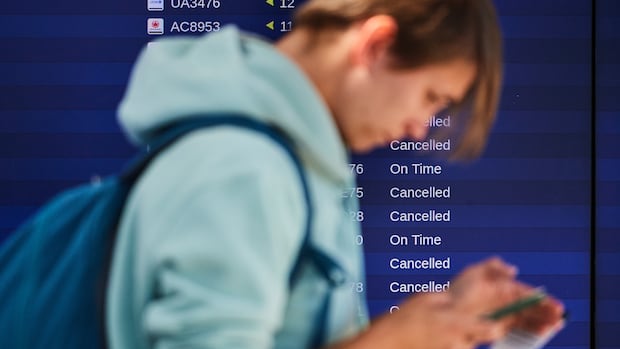
Internal government documents obtained by Go Public indicate that Transport Canada officials and successive transport ministers may have deliberately delayed and undermined efforts to make airlines contribute to Canada’s air passenger complaints system.
The obtained records reveal that Transport Canada, under two different transport ministers, interfered with the Canadian Transportation Agency (CTA), which was directed by Parliament in 2023 to establish a cost-recovery fee on airlines. Despite this directive, the fee has yet to be implemented more than two and a half years later.
Currently, taxpayers are shouldering approximately $30 million annually to handle air passenger complaints, leading to a backlog exceeding 88,000 cases. Passengers facing issues like flight delays or lost luggage can file complaints with the CTA, but due to the overwhelming volume, Parliament mandated the agency to charge airlines a fee for eligible claims as an interim measure.
To investigate the delay in fee implementation, Go Public submitted an Access to Information request covering the period from August 1, 2024, to May 20, 2025. The obtained over 2,000 pages of documents include correspondences between the CTA, transport ministers, internal discussions on addressing government concerns, and inputs from public consultations.
Gábor Lukács, the president of Air Passenger Rights, who reviewed the documents, highlighted ministerial interference with the CTA’s independent operations. However, both the CTA and Transport Canada declined interviews, providing only a general statement that did not address specific queries from Go Public.
After Parliament’s directive in 2023, the CTA proposed charging airlines $790 for each eligible passenger complaint, but faced opposition from airlines and industry representatives who argued against the fee, claiming it could lead to frivolous claims.
Former transport minister Anita Anand requested a delay in implementing the fee, criticizing the CTA for not consulting her before proceeding. However, constitutional law expert Pauly Daly deemed Anand’s stance as inappropriate, stating that consultation adequacy is the agency’s prerogative, not the minister’s.
Despite efforts to move forward with fee implementation, ongoing delays orchestrated by Transport Canada and various transport ministers have hindered the process, affecting passengers seeking rightful compensation. Lukács emphasized that the interference undermines Parliament’s mandate for the fee implementation.
The airline industry’s lobbying efforts have further stalled progress, with industry representatives holding numerous meetings with government officials to oppose the fee. As the backlog of air passenger complaints continues to grow, reaching over 88,000 cases, the delay jeopardizes Canadians’ ability to seek compensation as mandated by law.