
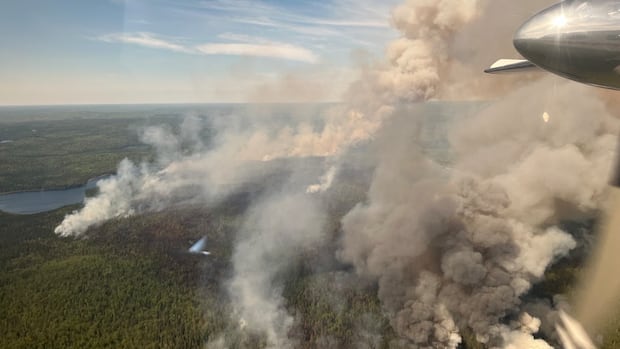
Amid Ontario’s most severe fire season to date, recent findings from McGill University highlight the protective role of aspen trees against wildfires. Flavie Pelletier, the main author of the study and a PhD graduate, noted that aspen have long been recognized for their resilience to fire, despite their thin bark. Analyzing satellite images of Canada’s boreal forest pre and post wildfires, Pelletier and her team observed that extensive patches of aspen can impede the spread of wildfires.
The research revealed that larger clusters of aspen were predominantly situated at the edges of burned areas, indicating their ability to slow down fires. Pelletier explained that aspen’s higher moisture content in both the trees and leaves, compared to coniferous species, contributes to their effectiveness as a fire barrier. Additionally, the positioning of aspen leaves higher on the trunk makes it less likely for ground fires to ignite them compared to coniferous trees like spruce and pine.
Despite the protective benefits of aspen, Pelletier highlighted a concerning trend in commercial forests where efforts are made to diminish their presence. Forestry companies in Ontario routinely spray vast hectares of Crown land with glyphosate, an herbicide aimed at eliminating broadleaf vegetation that competes with commercially valuable coniferous trees. This practice, known as the “war against aspen,” may heighten the long-term risk of wildfires by reducing the presence of aspen in these forests.
Fred Pinto, a forestry adjunct professor at the University of Toronto, acknowledged that while some studies show the return of broadleaf trees like aspen after glyphosate spraying, the process can take several years. Pinto emphasized that only a small fraction of Ontario’s boreal forest is harvested annually, with many ongoing fires in remote, unsprayed areas. Addressing concerns about the toxicity of wildfire smoke from sprayed forests, Pinto suggested that any residual glyphosate in the air would likely be minimal and would likely dissipate due to the intense heat of wildfires.