
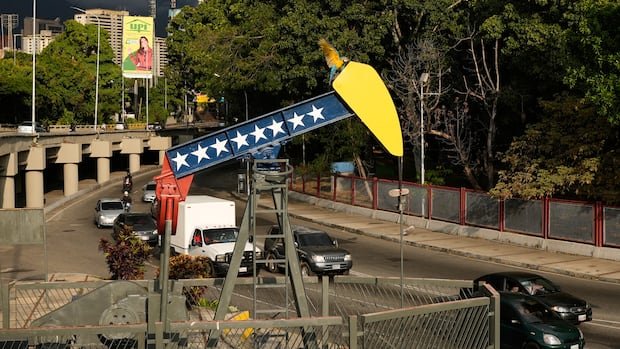
The primary focus of U.S. President Donald Trump in Venezuela is centered around the country’s oil reserves. With the recent capture of President Nicolás Maduro, attention has shifted towards the White House’s future actions in the region. To grasp the importance of this transition, here are six charts that highlight the magnitude and significance of Venezuela’s oil wealth.
Oil production in Venezuela has been on a downward trend since the mid-2000s, reaching its lowest point in 2020 due to stricter U.S. sanctions and reduced demand caused by the pandemic. Despite some modest recoveries since then, the country’s economic well-being is closely linked to its oil sales. The significant decline in oil production during the latter half of the 2010s led to a staggering contraction of about 30% in the economy in 2020. This economic collapse was largely attributed to decades of mismanagement, insufficient investment, and U.S. sanctions.
Although Venezuela’s oil production has been hindered, the country boasts vast reserves, likely surpassing those of major oil-producing nations like Saudi Arabia, Iran, and Canada. However, estimates indicate that a substantial investment of $180 billion over ten years would be required to restore production levels to those seen in the 1990s. Potential investors will have to navigate challenges such as political instability, aging infrastructure, and the current low oil prices.
Oil prices have been experiencing a decline, lingering above $60 US for several months. Speculations suggest that Venezuelan oil entering an already oversupplied market could further drive prices down. President Trump recently announced that Venezuela would supply between 30 and 50 million barrels of oil, to be sold at market prices. The U.S. administration is easing sanctions selectively to facilitate the shipment and sale of Venezuelan oil globally.
Most of Venezuela’s limited oil production is directed towards China, a key ally of the Maduro government and a significant investor in the region. Venezuela is currently repaying an estimated $10 billion debt to China, partly through oil exports. Following Maduro’s capture, U.S. Secretary of State Marco Rubio emphasized the U.S.’s commitment to preventing the Western Hemisphere from becoming a strategic hub for adversaries, competitors, or rivals, likely alluding to China.
While the U.S. has historically purchased a notable percentage of Venezuela’s oil, accounting for around 23% in 2023, the country’s position as an oil supplier to the U.S. has diminished. Trade data reveals that no Venezuelan oil was imported to the U.S. in 2020 and 2021, although small quantities were received in 2023 and 2024.