
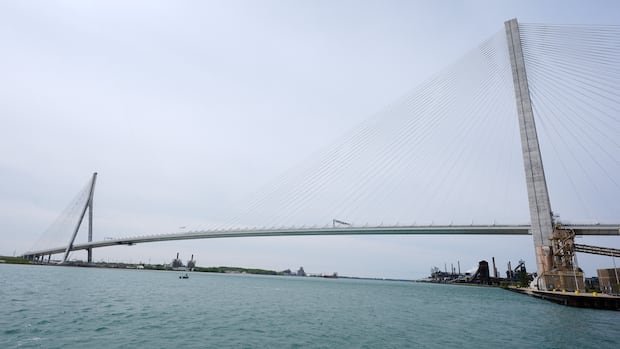
Prime Minister Mark Carney announced on Tuesday that the Gordie Howe International Bridge connecting Ontario and Michigan is set to open at the end of the week. However, a statement from the White House has cast doubt on the certainty of this timeline.
During a brief interaction with reporters before a cabinet meeting at Parliament Hill, Carney expressed optimism about the opening of the multibillion-dollar bridge, funded entirely by Canadian taxpayers. He emphasized that the bridge’s opening signifies cooperation between the two countries, benefiting both Canadians and Americans involved in cross-border travel and trade.
Although Carney did not provide a specific start time for traffic on the bridge, it is expected to facilitate seamless movement of people and goods between Highway 401 in Canada and Interstate 75 in the U.S., offering an efficient alternative to other congested border crossings.
Notably, a White House official, when questioned about the bridge’s opening, reiterated the president’s stance, indicating a commitment to ensuring a favorable deal for the American populace. This position could be linked to previous demands by U.S. President Donald Trump for a share of the toll revenues from a project that the U.S. did not financially contribute to.
Windsor Mayor Drew Dilkens shared his enthusiasm for attending the bridge’s inaugural event on Friday, anticipating a positive development. Dilkens acknowledged the potential influence of Trump on the bridge’s fate, given the project’s prolonged construction period and historical significance.
Despite Trump’s past objections and social media outbursts threatening to delay the bridge’s opening, the Canadian government, along with American workers, played a significant role in constructing the bridge, countering erroneous claims about its composition.
The Canada-Michigan Crossing Agreement, signed in 2012, solidifies the joint ownership of the bridge by Canada and Michigan, with the Windsor-Detroit Bridge Authority overseeing its operations. Canada will initially collect toll revenues to recover construction costs, with Michigan eventually sharing in the revenue once Canada’s expenses are recouped.
The project has generated thousands of jobs in Michigan, underscoring the economic benefits and cross-border collaboration facilitated by the bridge. Ontario Premier Doug Ford expressed cautious optimism about the bridge’s opening, amidst ongoing discussions to resolve trade disputes with the U.S.
While uncertainties persist, Ford remains hopeful about the prospects of renewing trade agreements, acknowledging positive signals from recent talks. However, challenges remain, particularly concerning tariffs imposed by the U.S. on Canadian exports.
Trump’s opposition to the Gordie Howe bridge stemmed from interactions with the Ambassador Bridge owners, who have long resisted the construction of the new crossing. Political connections and lobbying efforts by the Ambassador Bridge company further complicated the bridge’s progress, prompting scrutiny from Congress.
In conclusion, the Gordie Howe International Bridge stands as a testament to cross-border cooperation and economic vitality, despite political challenges and uncertainties surrounding its opening.