
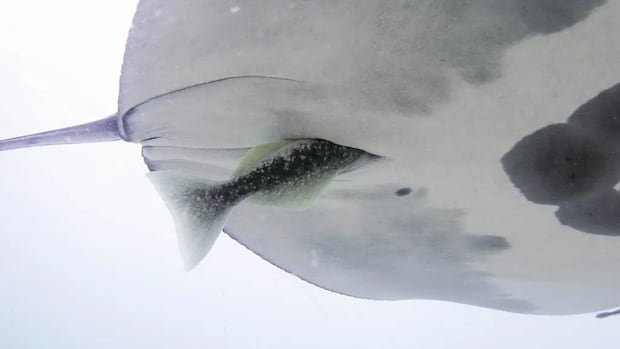
In a recent study led by marine researcher Emily Yeager from the University of Miami, it has been revealed that remoras, also known as suckerfish, may not always be the most considerate companions to manta rays during their oceanic travels. These small fish hitch rides on larger marine animals such as sharks and whales, feeding on parasites in exchange for the transportation provided. However, the study suggests that this relationship may have negative implications for manta rays.
The phenomenon, termed “cloacal diving,” involves remoras diving into the cloaca of their hosts, which serves as a multifunctional orifice for reproduction and waste excretion. While such behavior has been observed between remoras and whale sharks previously, this study presents the first documented evidence of this interaction with manta rays.
Researchers documented seven instances of cloacal diving over a 15-year period in various oceanic regions, indicating that this behavior may be more prevalent than currently known. The study suggests that remoras often wedge themselves deeply into the manta ray’s cloaca, potentially causing discomfort or harm to the host.
Brooke Flammang, a professor at the New Jersey Institute of Technology who has researched remoras, speculates that the behavior may be driven by a desire for food. Referred to as coprophagy, the act of consuming excrement, this behavior is not uncommon among certain species.
Although the exact impact of cloacal diving on manta rays remains unclear, Yeager raises concerns about potential skin damage and reproductive implications caused by the suction cup-like structures of remoras. This complicates the traditional classification of the relationship between the two species as symbiotic or commensal, suggesting that ecological interactions may exist on a spectrum rather than in rigid categories.