
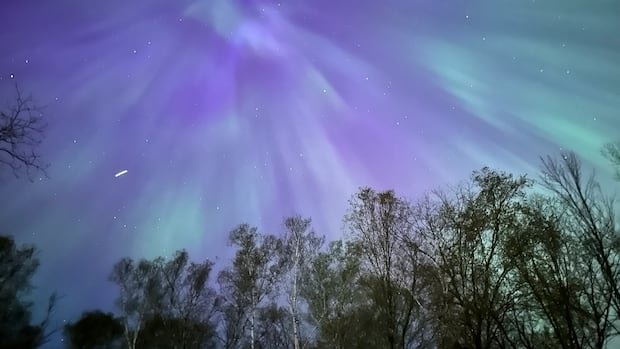
Residents of the Southern regions of Canada have recently been able to witness vibrant displays of purple, pink, and green lights in the night sky due to heightened solar activity over the last two years. However, as the sun transitions into a calmer phase of its 11-year cycle, the spectacle of the northern lights will diminish.
The prime locations to observe the dancing lights will continue to be in the Northwest Territories, Yukon, and Nunavut, where the auroral oval, a luminous ring encircling the magnetic poles, is most prominent, according to Ethen Sun, a Ph.D. candidate at the University of Toronto’s David A. Dunlap astronomy and astrophysics department.
Aurora sightings in Southern Canada, encompassing regions of Ontario, British Columbia, Saskatchewan, and Manitoba, will become less frequent as solar activity decreases. The sun undergoes periods of intense solar maximum and low-activity solar minimum.
“We are currently approximately a year and a half past the solar maximum,” Sun explained. “The activity is now declining, and it will eventually reach its minimum around 2031. Although the cycle is still quite active as we are in the latter stages, it is gradually decreasing.”
During the solar maximum phase, characterized by coronal mass ejections, flares, sunspot increases, and geomagnetic storms, the northern lights display vividly. Auroras can be observed almost nightly around the 60th parallel, regardless of solar activity.
The optimal time to witness the auroras is between September and April, with particularly bright shows occurring around the spring and autumn equinoxes. Despite being within the auroral oval, the heightened intensity experienced over the past couple of years may fade with declining solar activity, signaling a diminishing window for peak viewing.
Tourism in the Yukon has strategically leveraged the solar maximum period between 2023 and 2025 to attract visitors, highlighting the allure of the northern lights. Notably, travelers from the United Kingdom, Germany, Switzerland, and Australia exhibit keen interest in observing this natural phenomenon.
Aaron Ratko, a board member of the Wilderness Tourism Association of Yukon, noted that visitors are drawn to the territory for various experiences throughout different seasons. While some tourists initially visit during winter to witness the aurora in sub-zero temperatures, they often return during fall for a milder climate and diverse day tours.
In Nunavut, tourism focuses more on showcasing Inuit culture, heritage, scenic mountain ranges, landscapes, and wildlife, rather than solely on the northern lights experience. However, as solar activity diminishes and the Northwest Territories and Yukon emerge as premier aurora destinations, Nunavut may consider promoting itself as a key location for northern lights enthusiasts.
In the Northwest Territories, the northern lights are a common nightly occurrence, with Yellowknife boasting up to 240 nights of aurora displays annually. A substantial percentage of tourists are attracted to the region specifically to witness this natural spectacle.
Northern lights serve as a significant revenue source for the territories, filling accommodations, eateries, supermarkets, and supporting local businesses. While tracking the solar cycle, companies like Aurora Village in Yellowknife continue to engage visitors and promote the Northwest Territories as a prime destination for northern lights viewing.
As the sun’s cycle evolves, businesses in these regions remain adaptable to the changing conditions, providing visitors with unique and unpredictable aurora experiences beyond their expectations.