
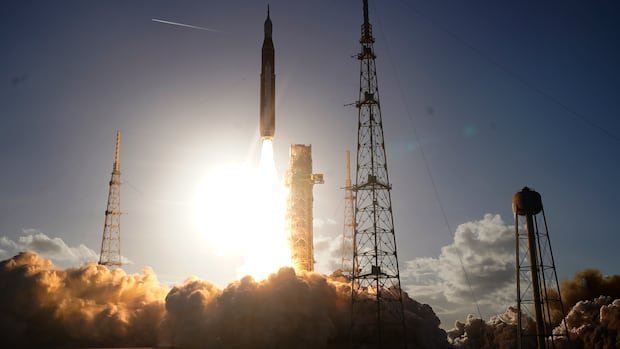
NASA’s Artemis program has garnered attention for its mission to send astronauts around the moon, marking a new competition between the United States and China to bring humans back to the lunar surface. This race goes beyond symbolic achievements, focusing on the strategic advantage of determining future lunar infrastructure locations, setting technical standards, and shaping the next phase of space exploration.
During NASA’s recent Ignition event, officials emphasized the urgency to return Americans to the moon before China does, particularly before the end of President Donald Trump’s term. Jared Isaacman, the billionaire nominated to lead NASA, highlighted the timeline disparity between the U.S. and China, stressing that success or failure would be measured in months, not years.
The race is now in full swing politically, with NASA aiming to land Americans on the moon by early 2028, while China’s chief designer, Wu Weiren, has confidently stated China’s ability to achieve this by 2030.
Despite skepticism about the feasibility of NASA’s 2028 target, experts note that China’s steady progress in space exploration has spurred political support for NASA’s endeavors. The current competition is viewed as a long-term endeavor rather than a swift sprint, focusing on establishing a sustained presence on the moon.
While the U.S. had previously pledged a 2024 return to the moon, shifting political priorities derailed that goal. In contrast, China’s cautious yet committed approach has lent credibility to their 2030 target.
Collaboration is also key in these missions, with NASA partnering with agencies from Canada, Europe, and Japan for the Artemis program, emphasizing a collective endeavor for the advancement of space exploration.
The strategic significance of the moon’s south pole, with its potential resources like water ice, adds urgency to the competition. The first country to land in this region could secure valuable sites for future operations, enabling access to essential resources for long-term sustainability.
The race for lunar dominance is not just about nationalistic pursuits but also about establishing a foundation for further space exploration. As countries vie for supremacy in space endeavors, the implications extend beyond prestige to shaping the rules and standards for future missions.
Funding remains a major challenge for NASA, prompting a reliance on private industry to bridge the financial gap. Competition between billionaire-led companies like SpaceX and Blue Origin underscores the evolving landscape of space exploration, where private entities play a pivotal role in shaping the future of space travel.
This new space race marks a shift from the past, with a U.S.-led effort involving international collaboration and private sector participation, contrasting with China’s state-driven, long-term strategy for space exploration. The moon serves as a crucial stepping stone for both countries, setting the stage for ambitious missions to Mars and beyond.