
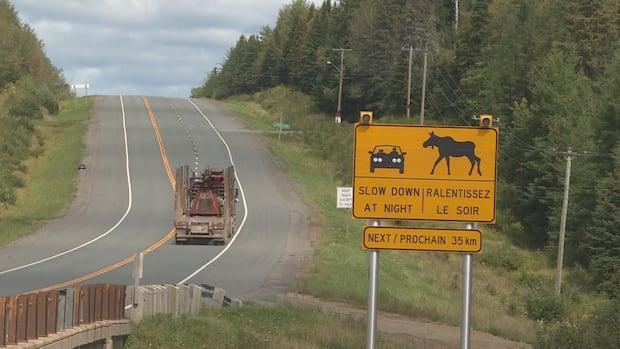
On a dark Saturday evening in late August, the Chaleur Lightning ice hockey team had just finished an exhibition match against the Miramichi Timberwolves and were on their way back to Bathurst on the team bus. Assistant coach Alex Ouellet recalled hearing the driver gasp shortly into the journey, followed by a loud bang as the bus collided with a moose on the highway. Fortunately, the team and coaches emerged unscathed, except for the driver who sustained minor scratches.
The encounter with the moose left a lasting impact on Ouellet and the team, a common experience for many New Brunswickers who have faced similar situations with large wildlife. This incident coincided with the announcement by the province of the addition of two new wildlife crossings along that particular highway stretch.
In an effort to prevent moose from straying onto roadways, New Brunswick implements wildlife fencing and crossings, including wildlife tunnels. Transportation Minister Chuck Chiasson explained that the placement of these measures is determined based on collision data provided by law enforcement to identify high-risk areas. Currently, 331 kilometers of highways in New Brunswick are lined with wildlife fencing on both sides.
The province has 82 wildlife crossings, such as concrete tunnels under highways, with two newly installed on Route 8 between Miramichi and Bathurst. These tunnels, over four meters tall and wide, are designed to accommodate various wildlife species. Wildlife ecologist Graham Forbes highlighted the importance of making the tunnels intuitive for animals to use, as observed in previous installations that saw animals utilizing the crossings within weeks.
Forbes also noted that the tunnels are not only utilized by large mammals but also by a variety of wildlife, including beavers, ducks, bats, skunks, and raccoons. Despite the presence of wildlife tunnels, the Department of Transportation has not seen a significant decrease in collisions, with 409 incidents recorded in 2024, including injuries and one fatality.
While the tunnels aim to enhance road safety, Chiasson emphasized the need for additional mitigation measures and maintenance, such as clearing brush for better visibility. Ouellet expressed hope for more fencing in the area to improve safety but acknowledged the challenges in preventing all collisions. He stressed the importance of implementing preventive measures while navigating the highways, recognizing the limitations in completely averting wildlife encounters.