
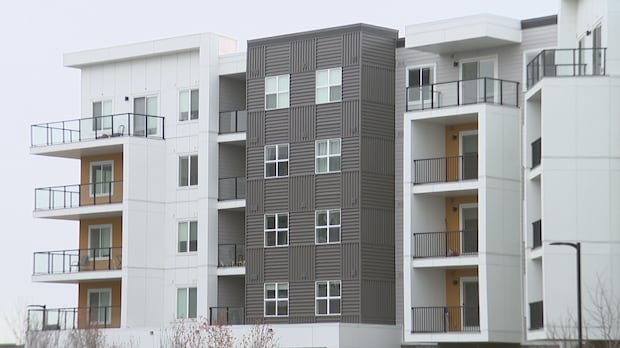
The dynamics of Calgary’s condominium market are shifting.
After a prolonged period of price increases, some sellers are now reducing their asking prices by substantial amounts to entice buyers.
With more housing developments on the horizon, the downward pressure on prices may persist.
“There is a significant surplus of inventory. Currently, demand is low,” stated realtor Sukh Pangly.
In a new project located in the northeast neighborhood of Cornerstone, he mentioned that prices have decreased by as much as $85,000 in order to sell condos that have remained unsold for several months.
Buyers are beginning to take notice.
“We started last month with around 100 units, and after our price reductions, we now have about 30 remaining,” Pangly revealed.
A two-bedroom, two-bathroom condo that was originally listed in the low $300,000 range is now available for $230,900.
A one-bedroom, one-bathroom unit in the same complex has seen a price drop of $55,000, now listed at $194,900.
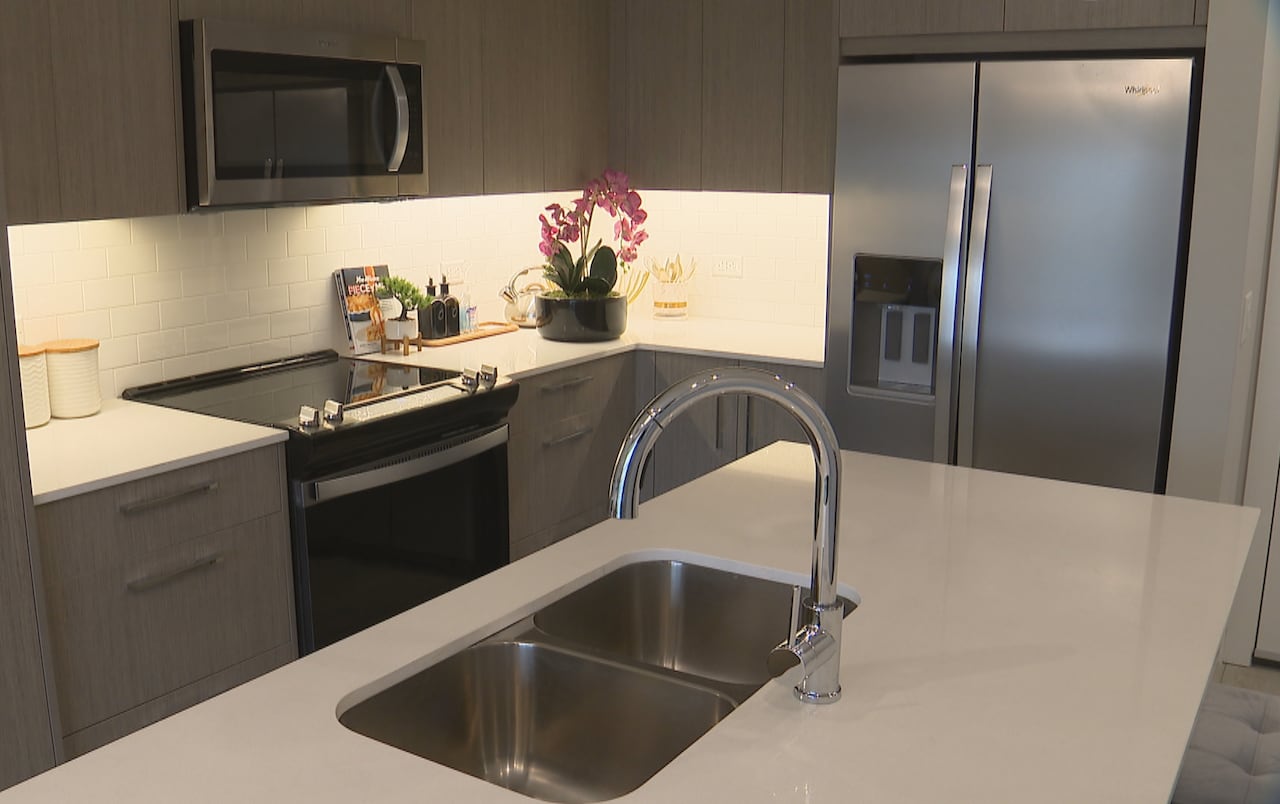
The price of this new two-bedroom, two-bathroom condo in northeast Calgary has dropped $85,000 to $230,900. (Ryan McLeod/CBC)
Pangly describes the drop as more of a price correction, but acknowledges that the reductions indicate increased competition among sellers.
This marks a significant shift in a city that, until recently, faced challenges in keeping up with housing demand due to its rapidly growing population.
According to the Calgary Real Estate Board (CREB), Calgary’s benchmark condo price dropped to $288,000 in October, reflecting an eight percent decline from the previous year and a 15 percent decrease from its peak in August 2024.

Realtor Sukh Pangly states that Calgary’s condo market is saturated. He notes that with a rise in supply and a decrease in demand, some developers are reducing prices by as much as $85,000 to attract buyers. (Ina Sidhu/CBC)
The Path to Calgary’s Current Situation
For many years, Calgary was a magnet for newcomers due to its comparatively affordable housing and job prospects, leading to a boom in home construction.
However, as the rate of population growth has decelerated, new challenges have emerged.
“The influx of migrants to the city is significantly lower than it was a few years ago, while we were building for a higher level of migration,” explained Ann-Marie Lurie, chief economist at CREB.
Lurie also pointed out that the slowdown is not solely due to fewer people relocating to Calgary. An increase in rental options is providing potential buyers with alternatives, while interest in investment purchases is waning.
“There is a greater variety of supply available, giving buyers more leverage in negotiations,” Lurie added.
Continued Housing Development
Calgary’s construction boom is far from finished.
In 2025, home construction in Calgary reached unprecedented levels.
Purpose-built rental projects accounted for the majority of this increase. Currently, over 17,000 apartment-style units are under construction, with approximately 70 percent designated as purpose-built rentals, according to CREB.
While these rental units may not directly increase the condo supply, Lurie believes they will still influence the overall market.
She noted that the pressure from supply could extend into the following year, leaving the future of prices uncertain.
Lurie emphasized that the slowdown does not uniformly impact all housing types.
According to CREB, the detached and semi-detached markets remain relatively stable, with prices holding firm.
In total, sales in October saw an 11 percent decline compared to the previous year.