
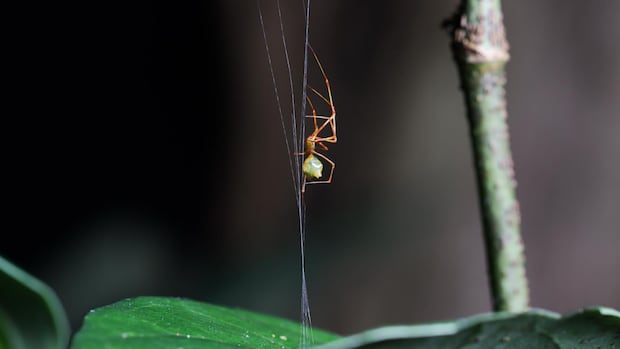
A newfound spider species in the tropical rainforests of Australia has amazed scientists with its unique hunting method that propels prey into the air using a silk trap equipped with a spring mechanism.
The discovery, detailed in a recent report in the journal Current Biology, showcases how this small arachnid constructs a cone-shaped snare to fling green tree ants into its web, leading to its moniker as the “ballista spider” reminiscent of ancient Roman projectile weapons.
Ajay Narendra, a biology professor at Macquarie University in Australia and one of the primary researchers, expressed awe at witnessing the spider’s behavior firsthand, describing it as a breathtaking experience. The spider, a member of the Propostira genus, is yet to receive an official species designation.
The initial sighting of this remarkable spider was made by researcher Greg Anderson in 2022 in a remote rainforest on Queensland’s Cape York Peninsula. Subsequently, a team from Macquarie University journeyed to northern Queensland in 2023 to investigate further. Employing high-speed cameras, the researchers spent ten days capturing the spiders’ unconventional hunting strategy, which proved challenging due to the swift nature of the attacks.
Measuring between three to five millimeters in length, these nocturnal spiders remain hidden under leaves during the day. At night, they emerge to construct intricate traps beneath their primary webs. By attaching silk tension lines to a lower anchor point, such as a leaf or branch, the spiders create a cone-shaped structure that, when triggered by an ant, launches the prey into the air, directing it straight into the waiting predator’s web.
The researchers observed that green tree ants were drawn to the trap within minutes of the final silk layer being added, suggesting the use of pheromones for specific prey attraction. This specialization in targeting green tree ants, known for their collective strength, may have evolved as a means for the spiders to hunt without direct confrontation.
Further investigation into the spider silk is planned to identify potential pheromones responsible for prey attraction. Saad Bhamla, an associate professor at the University of Colorado-Boulder’s BioFrontiers Institute, speculates that the green tree ants’ vigilant nature might play a crucial role in the spiders’ prey selection process.
With the ballista spider’s launch mechanism subjecting the prey to immense forces, exceeding those experienced by jet pilots, it stands out as a remarkable discovery in the realm of arachnid behavior. This natural wonder highlights the ongoing exploration and revelations in the field of biology, showcasing the endless mysteries waiting to be unraveled in the natural world.