
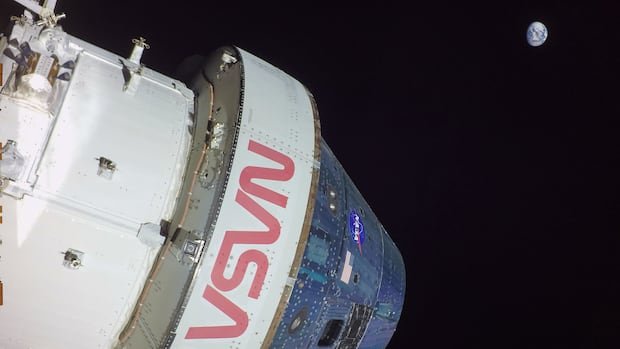
The Artemis II mission is nearing its conclusion with NASA astronauts Reid Wiseman, Victor Glover, Christina Koch, and Canadian Space Agency astronaut Jeremy Hansen completing their historic journey around the moon aboard the Orion spacecraft named Integrity. This mission marks the farthest distance traveled by humans in space exploration.
After their remarkable journey, the astronauts are scheduled to splash down in the Pacific Ocean off the coast of San Diego, Calif., tonight at 8:07 p.m. ET. The return journey to Earth involves intense conditions as the spacecraft reaches speeds of nearly 40,000 km/h, with the capsule heating up to 3,000 degrees Celsius.
During re-entry, the astronauts will experience almost 4 Gs, making them feel four times heavier than usual. This challenging phase was described by Glover as “Riding a fireball through the atmosphere is profound.” The return journey involves various critical steps before the crew lands safely on solid ground.
The European Service Module must detach from Orion before re-entry, typically happening around 20 minutes before the process begins. Following this, there may be a crew module raise burn to adjust Orion’s trajectory, along with roll maneuvers to separate it from the service module. As the spacecraft approaches its landing site about 16,000 kilometers away, the astronauts will prepare by lowering their visors.
As the capsule re-enters Earth’s atmosphere, a plasma build-up will cause a communication blackout between NASA ground control and the crew for approximately six minutes, known as Loss of Signal (LOS). Subsequently, the deployment of drogue parachutes will slow down the descent, ensuring a safe splashdown off San Diego at about 1,800 meters.
The recovery process involves the USS John P. Murtha ship meeting the astronauts, assisting them from the spacecraft to an inflatable raft named the front porch. Medical evaluations will follow, and the crew members will be transported to the Johnson Space Center in Houston.
Upon their return, the astronauts will undergo medical assessments, and the valuable scientific data they have collected during the mission will be analyzed and processed accordingly.