
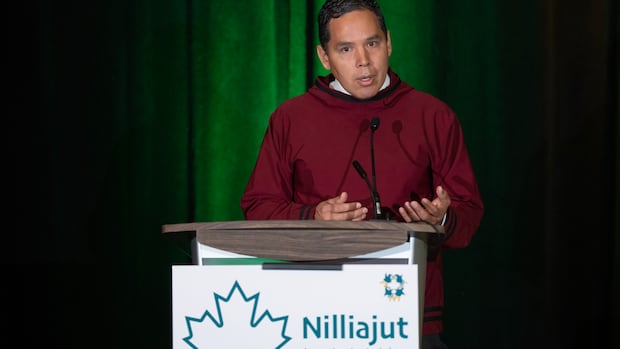
OTTAWA — The national Inuit organization of Canada is urging the federal government to enhance its collaboration, emphasizing the need for Canada to honor Inuit rights to self-governance and autonomy.
Inuit Tapiriit Kanatami concluded a two-day conference on Arctic sovereignty in Ottawa on Friday.
In a post-summit statement, ITK expressed its strong disapproval of what it describes as “outdated, colonial policies regarding Arctic governance that continue to marginalize” Inuit communities.
“We urge the federal government to work alongside Inuit to promote a more ambitious agenda for its Arctic region by prioritizing better coordination with Inuit rights holders in decision-making and investing in infrastructure and services that foster prosperity and integrate all of Inuit Nunangat with the rest of the nation,” ITK stated.
“Canada can only reach this goal by collaborating with the four rights-holding Inuit Treaty Organizations that represent all Inuit,” it added.
A representative for Crown-Indigenous Minister Rebecca Alty stated that Canada is dedicated to promoting Inuit self-determination.
“Inuit are key partners in creating a robust, secure, and prosperous Arctic,” said press secretary Alec Wilson. “Meaningful engagement with Inuit rights holders is crucial for achieving shared goals, including Arctic sovereignty, security, economic growth, and community well-being.”
<pEarlier in the day, ITK president Natan Obed remarked that if the partnership with Ottawa is no longer viable, Inuit will seek alternative partners.
He indicated that the current relationship with the federal government is positive, but noted there has been “a significant change” in how Ottawa engages Inuit in decisions impacting their territory.
This includes the federal government’s choice not to conduct “deep consultation” with Inuit before announcing defense investments and the proposed Northern Operational Support Hub network of logistics centers for the Canadian Armed Forces.
“We were informed and invited to celebrate alongside the Government of Canada when they made the announcement,” Obed told The Canadian Press.
“We are not an integral part of those discussions, despite them taking place in our homeland.”
While Obed acknowledged that Canada is the “preferred partner” of Inuit and expressed that they “have no desire to seek other avenues,” he stated that they would do so if deemed necessary.
“If the partnership with Canada is not an option, and if we are not treated as respected partners, should we not consider seeking other partners to safeguard our interests?” he asked the audience at the summit, with Alty listening from the front row.
“This isn’t a threat; it’s a practical consideration that I’m sure the Prime Minister’s Office contemplates daily regarding the decisions they make on behalf of Canadians. For Inuit… we must leverage our power and resources to withstand external interests in our homeland — not necessarily our people.”
Obed referenced Carney’s efforts to diversify Canada’s trade relationships amid U.S. President Donald Trump’s trade war, including rebuilding ties with India and China.
Obed indicated that Inuit leaders find themselves in a similar position, although he did not specify whether Inuit would pursue foreign investors or collaborate directly with foreign governments.
He highlighted that Arctic security, defense, and sovereignty are “top priorities” for Carney’s government, while the Arctic contains “strategic national assets for resource extraction.”
“Now it’s our turn to express a similar sentiment,” Obed conveyed to the audience.
He pointed out Canada’s renewed engagement with China, while also mentioning that “Inuit have been discouraged from collaborating with Chinese interests for natural resource extraction or subsurface considerations within parts of Inuit Nunangat.”
“So if we cannot find ways to advance significant projects with the Government of Canada, there may be other opportunities for us to work with different stakeholders to develop projects that support and advance our self-determination,” he told The Canadian Press.
When asked if Inuit would contemplate working more directly with Chinese investors on Arctic initiatives, Obed acknowledged they would first consult with Ottawa.
“We take threats to Canadian sovereignty very seriously,” Obed stated.
“We aim to be active participants in sovereignty and defense discussions regarding security. We want to ensure that our partners share these aims and objectives.”
Obed emphasized that large-scale projects are essential for funding the realization of Inuit treaties, social programs, and services, as well as creating job opportunities for Inuit.
“This is not occurring at present. However, there are valid considerations that I believe warrant serious attention,” Obed remarked.
“The manner in which the Government of Canada, along with provinces and territories, interacts with Inuit rights-holding institutions shapes the environment in which we make our decisions. We would be eager to collaborate with our preferred partners, the provinces, territories, and the federal government. However, we will explore other alternatives if necessary.”
This may extend to the Inuit Nunangat University, which is expected to open in 2030 with its primary campus in Arviat, Nunavut.
All universities in Canada require legislation to grant degrees. Obed stated that because the Inuit university could span multiple jurisdictions, Ottawa should collaborate with ITK on the necessary legislation.
“They have not committed to that,” Obed stated. “There may be other routes for us to enable our legislation, and perhaps there are other partners outside Canada willing to work with us to ensure we can offer degrees from the Inuit university.”
Obed also highlighted housing as another instance of Ottawa moving away from allowing Inuit to make independent decisions regarding social supports.
During the previous Liberal government’s funding allocation for housing, ITK would distribute funds to Inuit regions through a model established by its board.
Inuit organizations would then determine how to construct the housing.
Now, Obed noted, they are witnessing Ottawa revert to a model that involves closer collaboration with territorial governments instead of Inuit organizations.
“We are not seeing the same opportunities or the same regard for rights-based funding frameworks and fiscal policies. This is a significant concern for Inuit,” Obed indicated.
“We are also observing a return to a territorial North, rather than an Inuit Nunangat North.”