
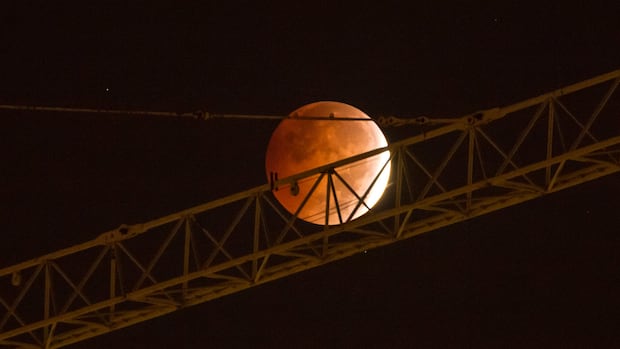
On the night of August 27-28, a deep partial lunar eclipse will be visible nationwide. Following the recent total solar eclipse in Iceland, Spain, and parts of Portugal, this partial eclipse will reach 93% coverage at its peak. Lunar eclipses occur when the moon passes through Earth’s shadow, transitioning from the outer penumbra to the darker umbra.
Most regions in Canada will have a clear view of the entire eclipse, while Western Canada will witness the partial eclipse as the moon rises. Unlike solar eclipses, watching a lunar eclipse does not require protective eyewear, and the event unfolds over hours rather than minutes.
The eclipse will commence as the moon enters Earth’s penumbra around 10 p.m. ET, with the visible phase starting at 10:33 p.m. ET on August 27 and concluding at 1:52 a.m. on August 28. The deepest darkness of the eclipse is expected at 12:13 a.m., with nearly the entire moon appearing shadowed.
This event adds to the celestial highlights of the month, as noted by Elaina Hyde from York University’s Department of Physics and Astronomy. While not a “blood moon,” the eclipse may still exhibit a reddish hue depending on the observer’s location in Canada. Lunar eclipses are easily observable with the naked eye, but binoculars, telescopes, or cameras with night mode can capture detailed images of the phenomenon.