
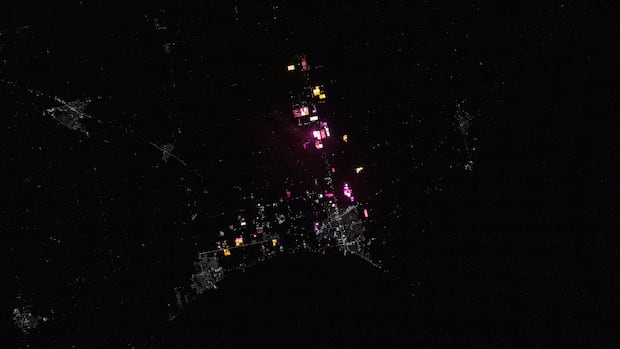
The vibrant hues of hot pink and canary colors shine brightly enough to be visible from space by astronauts. Positioned on top of the largest cluster of greenhouses in North America, these multi-colored lights have not only illuminated the night sky in a section of southwestern Ontario but have also revolutionized the multi-billion-dollar agriculture industry in the province.
In the past ten years, numerous vegetable and cannabis producers have installed thousands of lights within greenhouses in Leamington and Kingsville, Ontario, enabling year-round plant growth. The luminous glow emanating from this southern Canadian region, sometimes visible from as far as Michigan, has sparked both admiration and concern. This prompted local communities to establish bylaws restricting the brightness of the greenhouse lights after dark.
Richard Lee, the executive director of the Ontario Greenhouse Vegetable Growers, representing 170 members mainly in Essex County, acknowledges the challenges in adapting to the rapid technological advancements that have led to perceived light nuisances in the region.
Despite the implementation of rules to minimize light spillage into the sky, the radiant glow remains occasionally visible across the region and even from the International Space Station. Residents in Windsor and surrounding areas express both unease and curiosity about the source of this luminosity.
The proliferation of greenhouses in Kingsville and Leamington, as revealed in satellite imagery released by NASA earlier this year, is significant. This growth is partly attributed to Canada’s legalization of cannabis and the adoption of lighting technology facilitating year-round plant cultivation.
The demand for fresh produce, particularly during the disruptions in the food supply chain caused by the COVID-19 pandemic, has also played a crucial role in driving greenhouse expansion. The ability to grow various crops throughout the year has significantly increased profitability for growers and bolstered local food production.
However, the swift adoption of grow light technology has faced criticism due to ecological concerns in the region, known for its unique Carolinian ecosystems and its position within major migratory paths for birds and monarch butterflies. In response, both Kingsville and Leamington have enacted bylaws in recent years to address the escalating light pollution from greenhouses.
The bylaws in Leamington and Kingsville differ in their approaches to curtailing light pollution. Leamington’s bylaw mandates the installation of light-blocking curtains, while Kingsville’s prohibits any curtain “gapping.” Enforcement efforts have resulted in charges against greenhouse companies, but recent inspections indicate increased compliance with the regulations.
Studies conducted in the Leamington area have shown that the effectiveness of light-blocking curtains in reducing light emissions is proportional to the degree of closure. However, practical challenges may result in additional gaps that allow some light to escape. Factors such as weather conditions and the brightness of the moon can influence the perception of brightness despite efforts to minimize light emissions.