
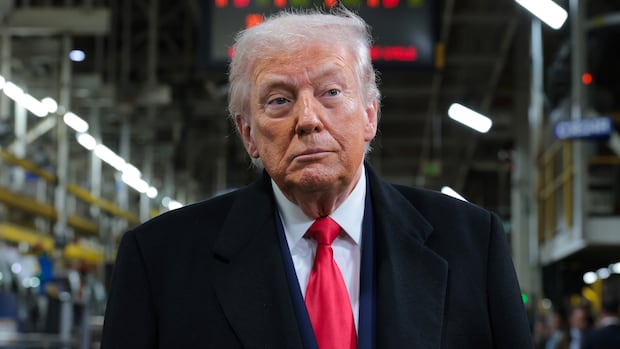
U.S. President Donald Trump dismissed the significance of the Canada-U.S.-Mexico Agreement (CUSMA) on Tuesday, stating that it holds no real advantage for the United States. However, he acknowledged that Canada is eager for the trade pact as he emphasized the importance of bringing manufacturing operations back to American soil.
Trump’s remarks came as he visited a Ford plant in Michigan and reiterated his stance that the U.S. does not require vehicles produced in Canada or Mexico. He emphasized the growing trend of companies relocating their manufacturing operations to the United States.
The Detroit Three automakers, including General Motors and Ford, heavily rely on supply chains that involve substantial parts production in Mexico and Canada. These companies collectively manufacture hundreds of thousands of vehicles annually in both countries. Industry experts have highlighted the critical role of CUSMA in American auto production, with major automakers advocating for its extension.
Mark Reuss, President of General Motors, emphasized the complexity of supply chains that span all three countries, noting the significant strength of the North American manufacturing network. Ford CEO Jim Farley echoed these sentiments, highlighting the integrated nature of manufacturing operations across the three countries.
As discussions on the future of CUSMA continue, Canada-U.S. Trade Minister Dominic LeBlanc is set to engage in talks with Mexican and U.S. counterparts to review the agreement. LeBlanc emphasized that the interests of Canadian workers and businesses will remain a top priority during the negotiations.
The CUSMA trade pact, which replaced the North American Free Trade Agreement (NAFTA), mandates a joint review by the three countries after six years. Trump, who has previously referred to CUSMA as a transitional deal, has hinted at the possibility of negotiating separate trade agreements with Canada and Mexico.
Observers interpret Trump’s recent comments as a call for Canada to diversify its trade partnerships beyond the U.S. border. Amidst the evolving trade dynamics, Prime Minister Mark Carney is embarking on a nine-day journey aimed at enhancing trade and investment opportunities, starting with engagements in China, followed by visits to Qatar and Switzerland for the World Economic Forum.