
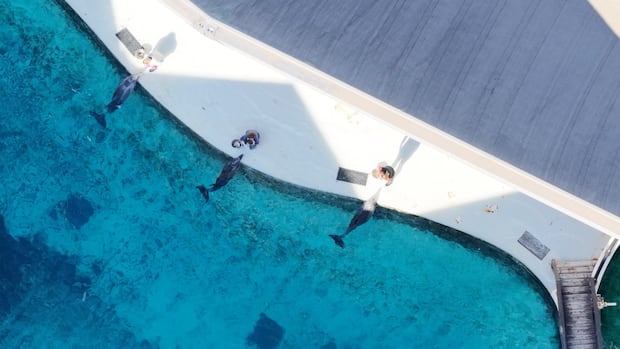
The Canadian government has conditionally approved Marineland’s request to relocate 30 belugas and four dolphins from its closed amusement park in Niagara Falls, Ontario, to facilities in the United States. Minister of Fisheries Joanne Thompson confirmed the approval following discussions with Marineland regarding the proposed export of the animals.
Marineland had previously indicated that without permission to transfer the belugas and dolphins to the U.S., they would have to be euthanized. Thompson described the recent meeting as productive and stated that she provided conditional approval for export permits, pending final information from Marineland.
Emphasizing the welfare of the whales, Thompson mentioned that her decision was guided by their best interests. The approved relocation is limited to specific U.S. institutions, and Marineland is required to provide detailed information on the animals’ destinations and a comprehensive transport plan.
A senior government source, speaking anonymously, highlighted the need for confirmation from Marineland that each animal has been assessed by a Canadian accredited veterinarian and deemed fit for transport before any relocation can take place.
Marineland aims to transfer the belugas and dolphins to Georgia Aquarium, Mystic Aquarium, Shedd Aquarium, and a SeaWorld location. Expressing gratitude for the support received from the Canadian government, Marineland acknowledged the minister’s backing for the animals’ relocation.
Independent experts from Shedd Aquarium, Georgia Aquarium, Mystic Aquarium, and SeaWorld visited Marineland to evaluate the belugas’ health and social interactions. While CAZA, the Canadian counterpart to AZA, confirmed that it was not directly involved in recent transport discussions, Marineland continues to care for its marine mammals despite closing to the public in 2024.
Animal Justice, an advocacy group, expressed disappointment over the conditional approval, stating that it is disheartening that the whales may not have the opportunity to live in a sanctuary. Executive director Camille Labchuk emphasized the importance of individual health assessments for each animal and ensuring that breeding does not occur in the U.S. to prevent further suffering in captivity.