
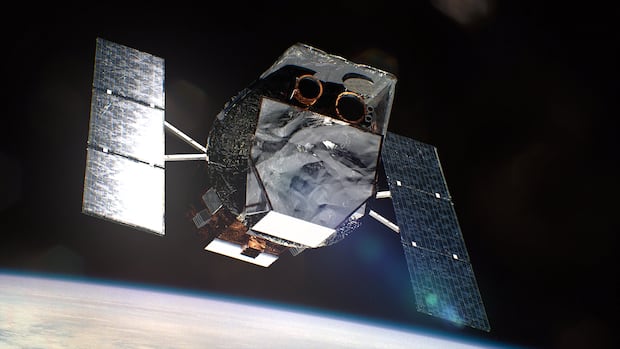
NASA and Katalyst Space are collaborating on a mission to prevent the Neil Gehrels Swift Observatory from prematurely burning up in Earth’s atmosphere. The observatory, designed to study gamma-ray bursts, is on track to disintegrate by the end of the year instead of lasting until 2030 as planned. To rescue the observatory, a robotic spacecraft named LINK has been developed to push Swift into a higher orbit, potentially prolonging its lifespan by a decade or more.
Brad Cenko, the principal investigator of Swift, emphasized the urgency of the situation, revealing that NASA typically takes decades to plan such missions, but this particular effort was expedited within a year and a half. Cenko expressed uncertainty about the mission’s success due to its unconventional nature for NASA.
The need for the rescue mission arose in early 2025 when Swift started descending rapidly towards Earth’s orbit, a consequence of unexpected solar activity. To address this issue, NASA enlisted Katalyst to construct LINK, a robotic spacecraft capable of interacting with Swift, despite the latter not being designed for in-space maintenance. LINK will be deployed using the Pegasus XL rocket attached to the Stargazer airplane, which will release the rocket in the atmosphere to intercept the satellite.
If the operation goes according to plan, LINK’s three robotic arms will secure Swift and provide the necessary push to raise its orbit. The entire process is estimated to take around two months. The success of this mission could mark a significant advancement in in-space servicing capabilities, opening doors for future endeavors like refueling, component replacement, and telescope assembly.
Mason Peck, a mechanical and aerospace engineering professor at Cornell University, highlighted the mission’s importance in advancing in-space maintenance technologies. He emphasized the potential for cost savings, preservation of scientific assets, and a sustainable approach to operating in Earth’s orbit. Despite the uncertainties, Cenko remains optimistic, acknowledging the valuable lessons learned from the swift execution of the mission, regardless of the outcome.