
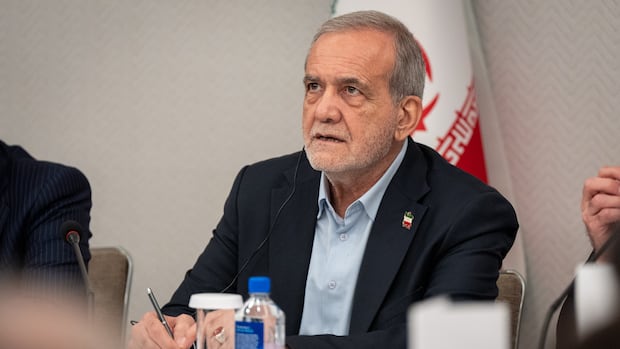
Iran’s leadership is facing internal divisions regarding a perceived existential war, as a clash between hardliners and more pragmatic factions has emerged over President Masoud Pezeshkian’s pledge not to attack Gulf states. Pezeshkian expressed regret to neighboring countries affected by Iran’s actions and urged them to avoid participating in potential U.S.-Israeli assaults on Iran. Despite dismissing U.S. President Donald Trump’s call for Iran’s unconditional surrender as unrealistic, Pezeshkian revealed that a temporary leadership council had agreed to halt strikes on nearby nations unless attacks on Iran originated from their soil.
In response, Trump interpreted Iran’s apology as a surrender and warned of significant retaliation on Saturday, hinting at the possibility of broadening the scope of attacks. Back in Iran, Pezeshkian faced backlash from hardliners in the Revolutionary Guard and clerical elite following his apology, leading to a partial retraction.
The rift within Iran’s ruling elite, previously suppressed under Supreme Leader Ayatollah Ali Khamenei’s authority, has now become more apparent amid mounting external pressures from U.S. and Israeli assaults. The ongoing bombardment poses a severe threat to the Islamic Republic and has prompted the Revolutionary Guards to assume a more prominent role in strategy despite losing key commanders.
The president’s subsequent restatement of his initial remarks on social media omitted the controversial apology, further aggravating the hardliners. With tensions escalating among top officials in Iran, senior ayatollahs publicly called for expediting the process of selecting a new supreme leader to counter external threats and maintain national unity.
In the Iranian political system, an elected president, government, and parliament are subordinate to a clerically-appointed supreme leader, who holds ultimate authority over powerful state institutions. Following Khamenei’s passing, an interim council, which includes Pezeshkian, the judiciary head, and a cleric from the Guardian Council, has taken temporary control.
The absence of Khamenei has exposed divisions even within this interim council, as noted hardliner Mohseni-Ejei pointed out regional states’ complicity in allowing attacks from their territories, signaling a continuation of aggressive responses contrary to Pezeshkian’s conciliatory tone.