
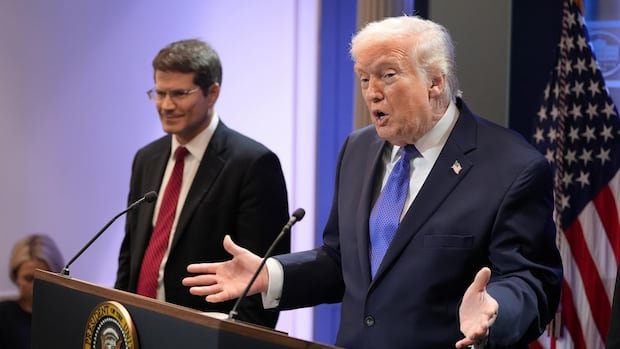
President Donald Trump has announced an increase in the global tariff rate by an additional five per cent, following a recent defeat in the U.S. Supreme Court. The original 10 per cent tariff was struck down by the court after being implemented using the International Emergency Economic Powers Act of 1977. Trump is now invoking Section 122 of the U.S. Trade Act to impose the new tariff rate of 15 per cent.
In a statement on social media, Trump mentioned a comprehensive review of the court’s decision and outlined plans to issue new tariffs in the coming months. These temporary tariffs, allowed under Section 122, can be in effect for up to 150 days unless extended by Congress.
Goods compliant with the Canada-United States-Mexico Agreement (CUSMA) will remain exempt from the latest duty, according to a White House fact sheet. However, specific sectoral tariffs, including those on Canadian steel, aluminum, copper, automotive parts, lumber, and wood products imposed under Section 232 of the U.S. Trade Expansion Act, are still active.
U.S. Treasury Secretary Scott Bessent suggested that the new global tariff could serve as a temporary measure while further studies are conducted on Section 232 and Section 301 tariffs. It is speculated that tariffs under Section 232 and Section 301 may increase in the future, potentially leading to the discontinuation of the current Section 122 tariffs.
The recent court decision focused solely on the legality of IEEPA tariffs and did not address the use of Section 232 tariffs. Trump’s decision to raise the global tariff to 15 per cent comes after the Supreme Court invalidated his previous tariffs, emphasizing the need for a review and adjustment in the trade policy landscape.