
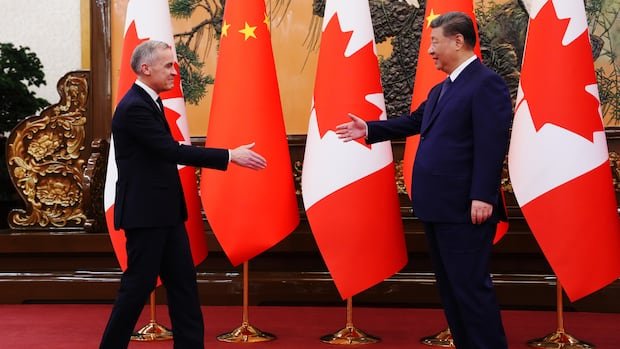
The Canadian government has struck a trade agreement with China that involves allowing a significant number of Chinese electric vehicles into the Canadian market while eliminating tariffs on canola products, Prime Minister Mark Carney announced on Friday.
This deal represents Carney’s first trade agreement with another country since assuming office and signifies a reduction in tensions with China, a country previously considered disruptive by the Canadian government. Carney hailed the agreement as a significant step in dismantling trade barriers and cutting tariffs, forming part of a broader strategic partnership with China.
During a press conference in Beijing, Carney emphasized the significance of the partnership, characterizing it as a realistic and mutually beneficial engagement. According to Carney, Ottawa anticipates a reduction of canola seed duties to 15 per cent by March, which he described as a substantial advancement.
The agreement entails the exemption of Canadian canola meal, lobsters, crabs, and peas from Chinese tariffs labeled as “anti-discrimination” from March until the year’s end. Conversely, Canada will permit up to 49,000 Chinese electric vehicles annually into its market at a tariff rate of 6.1 per cent, following the imposition of 100 per cent tariffs on Chinese electric vehicles in 2024.
Saskatchewan Premier Scott Moe expressed support for the tariff relief on canola products, emphasizing the significance of collaborative efforts between federal and provincial governments and export industries in strengthening trade relationships.
Carney highlighted the affordability benefits for Canadians resulting from the influx of Chinese electric vehicles, constituting a small portion of the domestic market, estimated at around three per cent. However, Ontario Premier Doug Ford criticized the deal, asserting concerns about potential negative impacts on Canadian workers and the automotive sector.
The trade agreement also aligns with the Canadian government’s objective to increase non-U.S. exports by 2030, including a 50 per cent boost in exports to China. Carney reiterated the importance of discussing human rights issues during his meeting with Chinese President Xi Jinping, emphasizing Canada’s commitment to values-based realism in its approach to international relations.
The agreement signifies a thaw in previously strained Canada-China relations, particularly in the realm of trade, following years of trade disputes and retaliatory tariffs. Carney’s visit to China and the subsequent deal reflect efforts to resolve longstanding trade issues and foster a more stable and predictable relationship between the two countries.