
Whales are facing a grim fate in the waters of British Columbia, with some being struck by vessels and others struggling to locate food due to the disruptive noise generated by ships.
In a distressing incident captured on video in May, a Sea-Doo was seen colliding with a grey whale near Vancouver, leaving witnesses shocked. Tragedy struck again last October when a humpback whale was hit by a whale-watching boat, and a deceased whale was later discovered in the same vicinity. Additionally, a humpback whale was struck by a B.C. Ferries vessel a month earlier, with another whale found dead the following day.
This troubling trend is on the rise and may escalate as ferry traffic increases alongside Canada’s efforts to transport more goods to Asia through these waters.
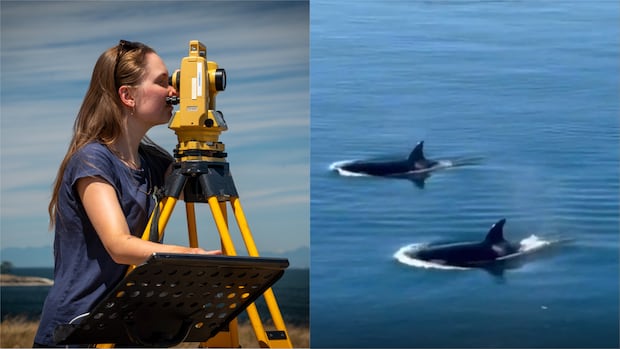
To combat this issue, two British Columbia organizations are taking action. One initiative, led by Simon Fraser University, known as HALLO (Humans and Algorithms Listening for Orcas), is dedicated to mitigating ship noise to enable endangered southern resident killer whales to access food resources. Lauren Laturnus, a biology master’s student at SFU, emphasized the importance of protecting these whales as integral components of the ecosystem.
Through HALLO, Laturnus uses surveying equipment to monitor whale movements in the Salish Sea while also keeping tabs on vessel traffic from East Point on Saturna Island, situated between Vancouver Island and the Lower Mainland.
When Laturnus spots whales, she promptly reports their presence to the Ocean Wise Whale Alert System, which notifies commercial mariners in real-time, enabling them to adjust their speed or alter their course to avoid collisions.
Apart from academic efforts, a group of around 100 volunteer citizen scientists have been trained to observe whale movements around Saturna, Pender, and Mayne Islands, providing valuable data to the Whale Alert System.
HALLO’s primary objective is to create an environment that allows southern resident killer whales to feed undisturbed. These orcas, which face critical endangerment, heavily rely on sound to navigate their surroundings, a process disrupted by vessel noise.
The southern resident orcas are among Canada’s most critically endangered marine mammals, with approximately 74 individuals remaining in British Columbia’s waters, excluding a new calf. Their main food source, chinook salmon, is dwindling, primarily found in the Salish Sea, a heavily traversed shipping route in North America.
Efforts to enhance whale protections have gained traction, with HALLO partnering with the W̱SÁNEĆ Marine Guardians, an Indigenous-led initiative in the Salish Sea. By strengthening the bond between First Nations communities and whales, the guardians aim to secure the survival of these majestic creatures and safeguard marine ecosystems.
Biologist Rachel Fairfield Checko analyzes hydrophone recordings to identify whale species and leverages traditional knowledge to advocate for enhanced whale protections from the federal government.
The W̱SÁNEĆ people successfully advocated for increased protections in the Tumbo Channel, leading to a voluntary slowdown zone from June 1 to November 30, 2026, emphasizing the need for year-round vessel restrictions.
Recent government measures have extended the distance required between vessels and the southern resident orcas from 200 meters to 1000 meters. Additionally, experts stress the urgency of implementing similar protections for humpback whales, which are frequently at risk of vessel strikes, as highlighted by the International Marine Mammal Project.
Innovations like an optical technology developed by Glenn Jones’ company, Reach Technologies, offer promising solutions. The 360-degree rotating multispectral camera system, initially designed for the Canadian Department of National Defence, can detect whales from a distance, alerting vessels to their presence and enabling them to take timely evasive actions.
Jones envisions integrating this technology into commercial vessels and ferries to prevent whale collisions and establish safer maritime routes. With whale populations rebounding and vessel traffic intensifying, it is crucial to prioritize coexistence and mutual respect between marine life and human activities.