
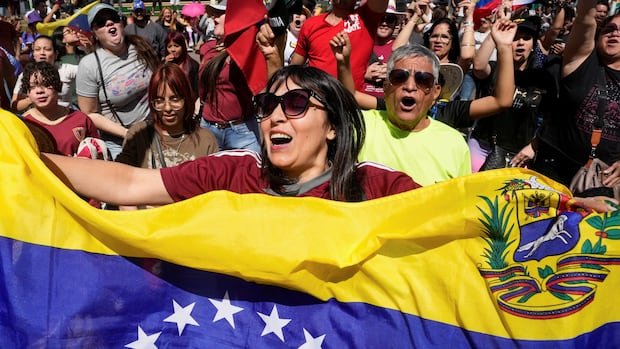
Venezuelan migrants worldwide erupted in jubilation on Saturday following the U.S.-led apprehension of President Nicolas Maduro, whose administration oversaw one of the most significant mass migrations in recent memory. In Chile’s capital, chants lauding Maduro’s capture reverberated as Venezuelan expatriates gathered to express their elation.
“We are liberated. We are all thrilled that the dictatorship has ended and we now have a free nation,” stated Khaty Yanez, a Venezuelan resident of Chile for the past seven years. “My happiness knows no bounds,” echoed her compatriot Jose Gregorio. “After numerous years of struggle and hard work, today marks a new era of freedom.”
Since 2014, an estimated 7.7 million Venezuelans, constituting 20% of the population, have left the country due to economic hardships or in pursuit of better prospects abroad, as reported by the U.N. International Organization for Migration. Colombia has accommodated the largest proportion of this diaspora with approximately 2.8 million Venezuelans, followed by 1.7 million in Peru.
In Lima, Peru, numerous Venezuelan expats draped in their national flag congregated to commemorate Maduro’s arrest. Milagros Ortega, a Venezuelan migrant with family still in Venezuela, expressed her emotional hope of returning.
Peruvian President Jose Jeri announced the facilitation of the immediate return of Venezuelans, irrespective of their immigration status. Over the years, the U.S. has been a sanctuary for many Venezuelans, but during President Donald Trump’s second term, a significant number had to seek refuge elsewhere.
In Spain, a multitude gathered at central Madrid’s Puerta del Sol, applauding as they watched Trump’s live press conference. Speculation about Venezuela’s future looms large as Venezuelans abroad ponder on the prospects for their homeland and its citizens.
Andres Losada, a Venezuelan resident in Spain, shared his mixed emotions about the situation back home, acknowledging the uncertainty that lies ahead. Despite the challenges faced in Caracas, Losada remains optimistic about a brighter future for Venezuela.
Security forces patrolled the quiet streets of Caracas on Saturday, with most residents staying indoors, monitoring the unfolding events on their devices. Agustin Rodriguez, vice president of a Venezuelan cultural association in Spain, expressed apprehension over the strikes while acknowledging their potential necessity to pave the way for a new era in Venezuela.