
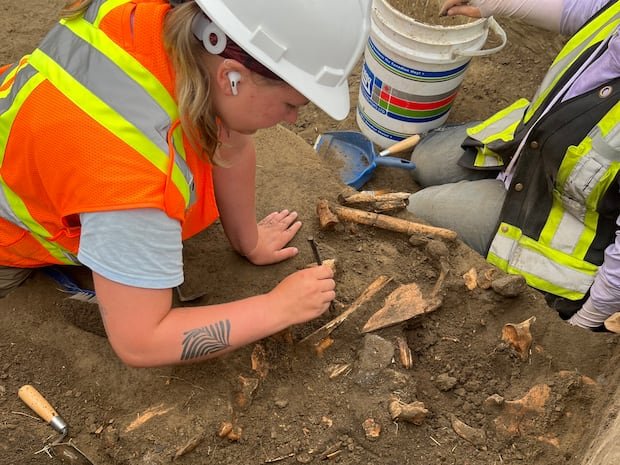
Around 240,000 artifacts discovered at an archaeological site in Moose Jaw, Saskatchewan, are shedding light on the extensive human history in the Wakamow Valley. The latest findings were unveiled by archaeologists during presentations at the Moose Jaw library recently.
Bill Strongarm, a member of the Federation of Sovereign Indigenous Nations from the Touchwood Agency Tribal Council, expressed his satisfaction with the discovery of the site and artifacts, emphasizing its sacred significance to him. He mentioned that the site served as a camping ground for the Saulteaux and Assiniboine people en route to the Cypress Hills in southwest Saskatchewan, where some likely stayed for extended periods.
These artifacts represent a layer of narratives that warrant further exploration into Indigenous history, according to Strongarm, who envisions the establishment of a heritage center to safeguard the area’s cultural heritage.
Alan Korejbo, a senior archaeologist at Respect Heritage Consulting, noted that the excavation was prompted by impending construction near a highway. The artifacts retrieved, dating back to pre- and post-European contact periods, indicate human activity in the region spanning over 12,000 years. The diverse collection includes stone and bone tools like projectile points, scrapers, awls, and knives, some crafted from bison bones.
Of particular interest are the plant and pottery remnants found at the site, with pottery styles suggesting origins from areas in southern Manitoba, Ontario, and Minnesota, rather than Missouri as initially presumed. Microscopic analysis of plant residues on artifacts revealed evidence of cultivation, such as wild rice, beans, corn, and squash, hinting at a potential agricultural site unique to Saskatchewan.
Korejbo highlighted the significance of further research and analysis of these artifacts at the Royal Saskatchewan Museum to deepen the understanding of this historical site. The discoveries not only validate the enduring presence of Indigenous peoples on the continent but also spark pride and admiration for these significant archaeological findings.