
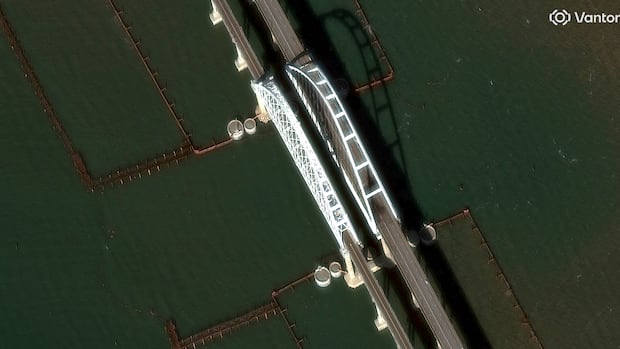
On Tuesday, Ukrainian drones and missiles struck the central roadway of the bridge connecting Russia and Crimea, delivering a significant military and symbolic defeat to President Vladimir Putin just two days ahead of his scheduled meeting with the leaders of China and the U.S.
Footage and photographs shared on X by Ukrainian President Volodymyr Zelenskyy and authenticated by Reuters depicted the collapse of the bridge’s central arch into the sea, resulting in a stark opening.
“Russia assaults our infrastructure daily, including bridges,” Zelenskyy noted. “We are … reminding Russia that war will inevitably return to its origins.”
The bridge, spanning 19 kilometers, was a prominent project inaugurated by Putin in 2018 and represents Russia’s connection to the peninsula that was seized and annexed from Ukraine in 2014.
The incident comes at an inconvenient time for the Kremlin, as Putin is set to meet with U.S. President Donald Trump and China’s Xi Jinping on Thursday in Shenzhen, where discussions on the Ukraine conflict are anticipated among other subjects.
According to Zelenskyy, the attack succeeded following an exceptional operation that systematically dismantled Russian air defense systems, radar installations, and electronic warfare capabilities.
Sergei Aksyonov, the governor installed by Russia in Crimea, reported two fatalities and the suspension of road traffic, although rail services resumed partially after a brief halt.
Kremlin states plans to reconstruct bridge
Dmitry Peskov, Putin’s spokesperson, announced that a plan for repairs would be developed, aiming to enhance the bridge beyond its previous state.
However, Russian military analysts expressed doubts about the feasibility of repairs due to Ukraine’s ongoing potential for further assaults.
Finnish military expert Emil Kastehelmi stated on X: “The road bridge will not be restored during this conflict … Ukraine has secured a victory with both tangible and symbolic significance.”
Previously, the bridge over the Kerch Strait served as a vital supply route for Russian troops in Ukraine. Currently, the military has shifted to relying more heavily on a land corridor that passes through regions in eastern and southern Ukraine, which Russia has occupied since initiating a full-scale war against its neighbor in 2022.
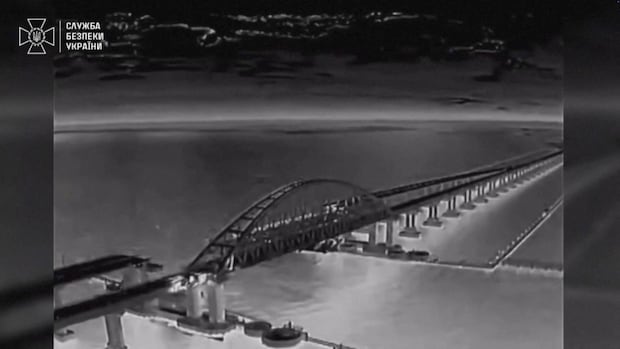
Ukraine has released footage of its drone and missile attack that destroyed the central road section of the key bridge linking Russia and Crimea on Tuesday.
Marat Khusnullin, Russia’s Deputy Prime Minister, mentioned that a government committee convened to evaluate the damage, initiate repairs, and explore alternative routes for cargo delivery to Crimea.
The bridge serves as a passage for commercial ships entering and exiting the Sea of Azov, thus playing a critical role in the region’s grain export infrastructure.
Although grain shipments from the Black Sea have significantly declined amid rising drone assaults, the damage to export facilities has been minimal, allowing for a quick resumption of trade should safety conditions improve.
-
Russia says Ukrainian aerial attack involved more than 1,300 drones
-
Satellite limitations imposed by Musk’s SpaceX pose danger for Ukraine, Zelenskyy says
Andrey Sizov, from the consultancy Sovecon, indicated that the bridge’s collapse could “significantly hinder any potential resumption of shipping from the Sea of Azov,” as debris would need to be removed from the waterway.
Ukraine has targeted the bridge multiple times throughout the conflict. A truck bomb in October 2022 resulted in four fatalities and restricted the bridge’s capacity for several months. In July 2023, a segment of the road bridge was destroyed, leading to the deaths of a couple traveling by car.
Largest Ukrainian drone assault
The overnight assault was described by Russian state media as Ukraine’s largest drone attack to date. Russia reported intercepting 1,441 drones across 22 regions, exceeding the previous high of 1,336 recorded on Monday.
Air defenses successfully thwarted a significant drone strike aimed at the industrial cities of Ufa and Salavat in Bashkortostan, where several oil refineries are located, according to local officials cited by state media. Ukraine claimed it targeted a refinery and a petrochemical complex in Salavat.
Moscow Mayor Sergei Sobyanin stated that approximately 800 Ukrainian drones approached the surrounding areas of Moscow, with 321 intercepted before reaching their destination.
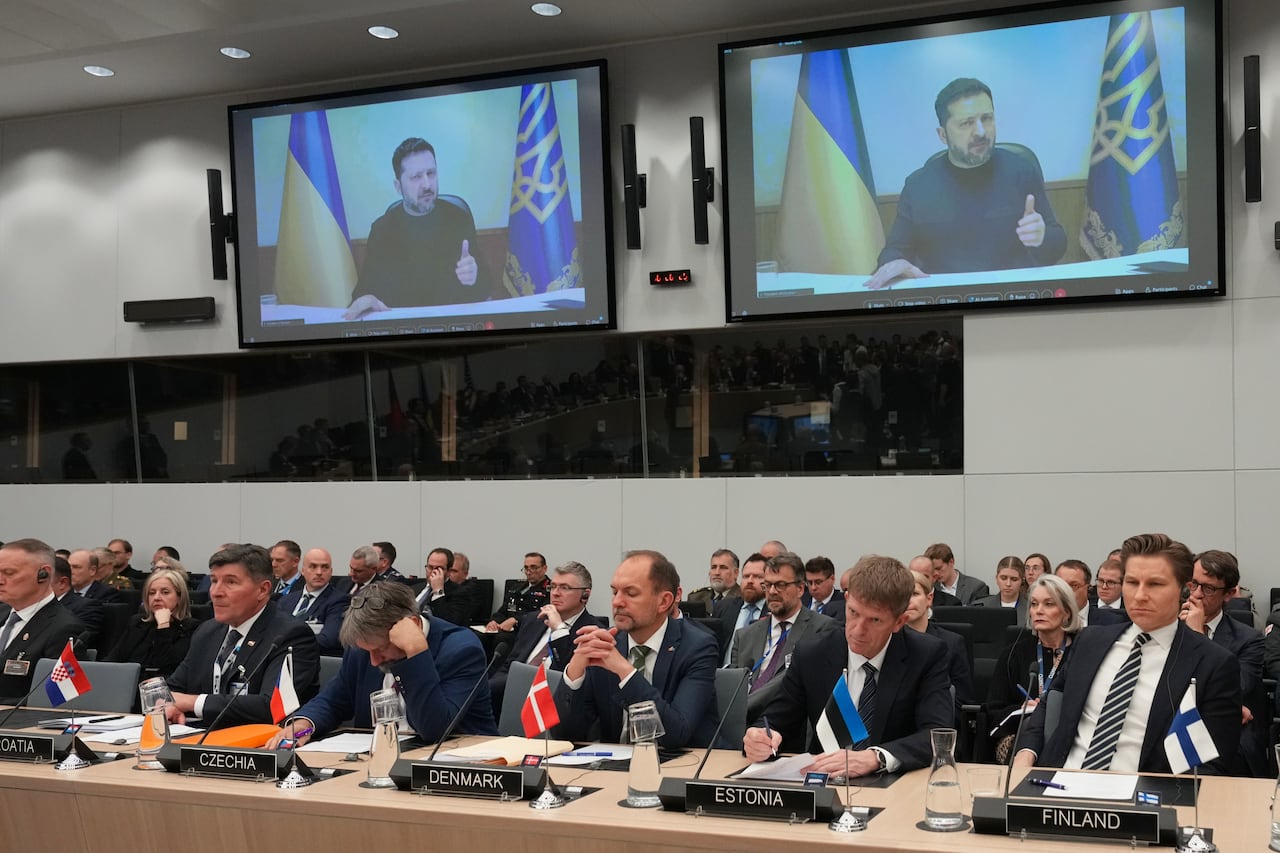
Ukraine’s President Volodymyr Zelenskyy, on screen, addresses a meeting of the Ukraine Defence Contact Group at NATO headquarters in Brussels on Tuesday. (Virginia Mayo/The Associated Press)
The magnitude and regularity of Ukrainian drone operations have escalated as Russia has intensified its own aerial and missile offensives in a protracted war of attrition, with both sides targeting critical energy infrastructure and other strategic assets.
These assaults have persisted despite U.S.-mediated peace discussions in Abu Dhabi last week, marking the first such talks in nine months, along with separate meetings involving U.S. representatives and both Putin and Zelenskyy.
During last week’s negotiations, Kyiv and Moscow reached an agreement on a significant prisoner exchange, but there were no substantial developments on broader issues, including territorial disputes. Russia currently occupies about one-fifth of Ukrainian territory, yet the front lines have remained relatively unchanged for several months.
Bridges in Kyiv targeted
In Kyiv, Reuters reporters observed a series of loud blasts in the capital overnight.
Mayor Vitali Klitschko reported that Russia targeted the North and South bridges of the city, a claim later confirmed by Moscow, resulting in partial damage to the metro system. These attacks caused some outages of power and water, alongside transport restrictions, he noted.
Overnight Russian strikes on energy facilities left consumers without electricity in eight regions of Ukraine, according to Deputy Energy Minister Artem Nekrasov.
Russia asserted that its military operations had targeted transportation, military, and energy infrastructure in Kyiv, Zaporizhzhia, Cherkasy, and Dnipropetrovsk, as well as port facilities and a cargo vessel.
Reuters could not immediately verify these claims independently. Both parties deny intentionally targeting civilians.