
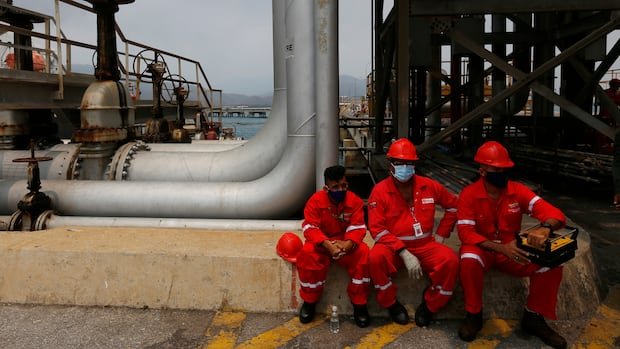
U.S. President Donald Trump’s strategy to assume authority over Venezuela’s oil sector and urge American corporations to reinvigorate it post the capture of leader Nicolas Maduro in a raid is expected to encounter numerous challenges — operationally, legally, and politically.
The dramatic capture of the Maduros marked the culmination of an extensive pressure campaign by the Trump administration against Venezuela’s authoritarian leader and months of clandestine preparations, culminating in the most forceful American effort to effect regime change since the 2003 Iraq invasion.
Washington has charged Maduro with narco-terrorism, while the Venezuelan government has long asserted that Trump and the U.S. aimed to exploit the nation’s abundant natural resources.
Venezuela boasts the world’s largest confirmed crude oil reserves, estimated at around 303 billion barrels, surpassing both Canada and Saudi Arabia, and constituting approximately 17% of global oil reserves.
Despite these substantial reserves, Venezuela’s crude oil production has dwindled to less than 1% of the global supply, with output plummeting from 3.5 million barrels per day in 1999 to the current level of roughly a million barrels per day, as reported by OPEC.
There exist several factors contributing to this decline and numerous obstacles that Trump must surmount to realize his vision of exporting Venezuela’s oil.
Infrastructure in Venezuela’s oil sector has deteriorated due to nationalization, mismanagement, and corruption, according to Heather Exner-Pirot, Director of Energy, Natural Resources, and Environment at the Macdonald-Laurier Institute. The country’s oil industry, along with other sectors of its economy, has also been adversely impacted by stringent U.S. sanctions imposed since 2015 when Caracas was labeled a national security threat.
Additional sanctions imposed by Trump in 2017 and 2019 severely limited Venezuelan oil exports to the U.S., culminating in a complete blockade on the industry, described by Secretary of State Marc Rubio as a “quarantine on their oil.”
Roxanna Vigil, an international affairs fellow at the Council on Foreign Relations, highlighted that revitalizing the oil sector in Venezuela would require years, if not a decade or more, and entail investments amounting to tens of billions of dollars.
Moreover, there has been a depletion of skilled personnel in the industry following the dismissal of thousands of workers from the state-owned Petroleos de Venezuela S.A. (PDVSA) by former president Hugo Chavez in response to a 2003 strike.
Trump announced plans to permit “major U.S. oil companies” to enter Venezuela, pledging that they would invest the necessary funds to rehabilitate the dilapidated infrastructure and generate revenue for the nation.
Francisco Monaldi, Director of the Latin American Energy Program at Rice University, emphasized that apart from the infrastructure challenges, attracting foreign investments hinges on ensuring political stability, clear contractual frameworks, and other pertinent factors.
Venezuela would need to revise its constitution to foster a more business-friendly environment and transition its economy away from socialism, as advocated by Vigil.
Legal experts have raised concerns about the legality of the recent U.S. operation in Venezuela and Trump’s aspirations for the nation’s oil reserves. While there may be historical precedents for U.S. intervention in Venezuela, questions linger regarding the appropriateness of enriching an occupying military power by exploiting another country’s resources.
Matthew Waxman, a Columbia University law professor and former national security official, highlighted the principle of “permanent sovereignty” over natural resources enshrined in UN Resolution 1803, emphasizing that foreign investments should be based on mutual agreements with the affected nations.
Despite Washington’s assertions to maintain a hands-off approach in governing Venezuela, the U.S. has augmented its military presence in the region, with Trump signaling intentions to exert influence over the nation.
In light of these developments, the issue of ownership of Venezuela’s oil resources remains contentious, with conflicting claims and historical references to U.S. involvement in the nation’s oil industry in the early 20th century.
Stephen Miller, White House Deputy Chief of Staff for Policy and Homeland Security Adviser, asserted that American contributions were instrumental in establishing Venezuela’s oil sector and insinuated that the industry was exploited by successive Venezuelan administrations.