
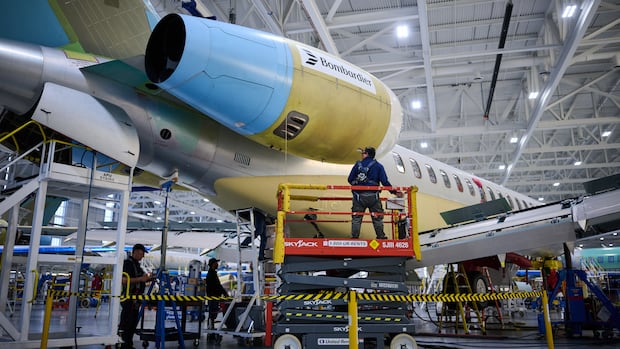
U.S. President Donald Trump declared on Monday that Bombardier, a Montreal-based aircraft manufacturer, will no longer have authorization to sell their products in the United States unless they commence production within the country.
In a message posted on Truth Social, Trump emphasized, “NO MORE SELLING BOMBARDIER IN THE UNITED STATES! Their products do not meet our standards! If they seek access to our market, they must establish manufacturing facilities here and refrain from treating America as simply a financial resource.”
This statement by Trump, occurring amidst an escalating trade conflict between Washington and Ottawa, represents his ongoing effort to compel both foreign and domestic companies to increase their manufacturing operations within the U.S.
One of the key focal points of his recent policies, including the imposition of widespread tariffs, is to encourage more domestic production. Concurrently, Canada is preparing to implement retaliatory tariffs against the U.S. starting early Tuesday.
Quebec Premier Christine Fréchette responded to Trump’s remarks by highlighting Bombardier’s significance to Quebec’s economy and its global aerospace presence, noting that the company serves as a point of pride for the region. She expressed support for Bombardier and its CEO, Eric Martel.
Despite Trump’s stance, Bombardier already maintains a significant presence in the U.S., with a workforce of 3,500 employees and 2,800 suppliers in the country. The company has reiterated its commitment to investing in the U.S. and creating job opportunities.
Furthermore, industry experts believe that Trump’s actions targeting Bombardier may not have the intended impact, as the company’s aircraft comply with trade agreements and have substantial ties to the U.S. supply chain. Aerospace analysts also doubt the feasibility of halting Bombardier jet sales, given their reliance on U.S.-made components.
Looking ahead, it remains uncertain how Trump intends to enforce his directive against Bombardier, especially considering the company’s existing manufacturing operations and partnerships within the U.S. The aerospace industry, much like the automotive sector, operates on a global scale with intricate supply chains that are deeply interconnected.
In conclusion, while Trump’s focus on boosting domestic manufacturing is evident, the complexities of modern industries like aerospace underscore the challenges of enforcing unilateral restrictions on international trade partners.