
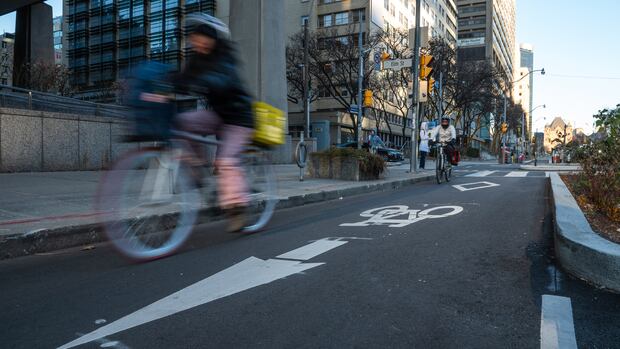
A Toronto cyclist group appeared in Ontario’s highest court to uphold their successful challenge against the province’s proposal to remove three sections of the city’s bike lanes. The cyclists, which include a bike courier and a university student, contended that the untested plan to eliminate protected bike lanes poses a safety risk and violates their constitutional rights. The Court of Appeal for Ontario heard the provincial government’s appeal of the case.
The province argued that the lower court’s ruling would establish a right to bike lanes, a claim rejected by a Superior Court justice. Justice Paul Schabas determined that the government pursued the plan despite advice from its own experts indicating it would not alleviate traffic congestion and could potentially exacerbate the issue. He concluded that the potential harm to cyclists far outweighed the minimal benefit of saving a few minutes of travel time for drivers.
Schabas highlighted that removing or altering the bike lanes to eliminate their separation would result in more accidents, injuries, and fatalities. The government’s inclusion of an immunity clause in the legislation further indicated their acknowledgment of the increased risks. Premier Doug Ford’s administration passed a law in 2024 to remove 19 kilometers of protected bike lanes in Toronto along Bloor Street, Yonge Street, and University Avenue.
A 2024 Toronto city staff report suggested that the risk of cyclist injuries on major streets without cycling infrastructure is approximately nine times higher than on protected bike lanes. The report cited research showing that a significant number of cycling-related deaths and injuries occurred on streets lacking safe bike lanes.
Regarding the province’s attempt to amend the legislation during the legal proceedings, Schabas deemed it a maneuver to circumvent his ruling. He emphasized that as long as the province aimed to eliminate separated bike lanes to restore vehicle traffic, the core issue remained unchanged.
In its defense, the province contended that Schabas misinterpreted the Charter’s provisions related to safety impacts and legislation. Premier Ford criticized the lower court’s decision, expressing his preference for bike lanes on secondary roads over major thoroughfares. However, evidence presented to the court indicated that alternative routes on secondary roads were not viable for many sections of the affected bike lanes, potentially endangering cyclists.
Toronto Mayor Olivia Chow’s spokesperson mentioned ongoing efforts to find mutually beneficial solutions that accommodate both car lanes and protected bike lanes. Estimates suggest that removing the bike lanes could cost around $48 million, although the province’s transportation minister initially disputed this figure without providing an alternative.
Subsequently, the government announced plans to reinstate vehicle lanes while retaining bike lanes on a portion of Bloor Street at a cost of $750,000. While some viewed this as a compromise, others questioned its feasibility for all the targeted bike lanes. Cycle Toronto, a cycling advocacy group leading the legal challenge, welcomed the adjustment but raised concerns about its applicability to all affected lanes.
Ahead of the hearing, Michael Longfield from Cycle Toronto emphasized the case’s importance in upholding the rule of law and criticized the government’s allocation of resources to a divisive issue. The appeal decision rests with a panel of three judges and is expected to be announced at a later date.