
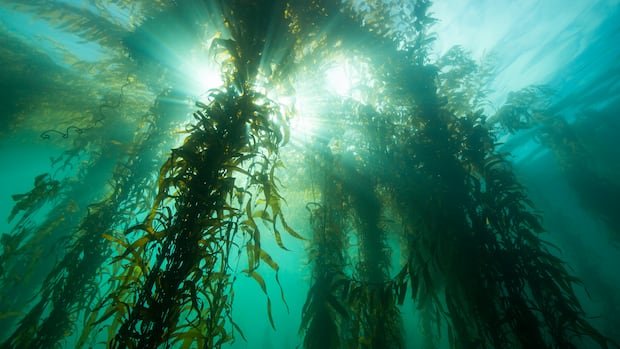
Near the Dallas Road breakwater in Victoria, there is a vibrant presence of lush kelp forests beneath the cold waters, as highlighted by Brian Timmer, a PhD student at the University of Victoria. While these kelp forests thrive due to the cold water conditions, other regions in British Columbia are experiencing warming microclimates, leading to the decline of once-thriving kelp ecosystems.
A recent study led by Timmer from UVic and published in Ecological Applications utilized historical data spanning back to 1972, including maps, scuba surveys, and aerial photos, to examine the status of kelp and associated macroalgae communities in the northern Salish Sea. The study revealed that the vast bull kelp forests that previously covered over 5.5 million square meters in the northern Salish Sea, specifically around the Comox and Denman Island region, have disappeared. This loss is ten times greater than the previous baseline estimation set around the year 2000.
Satellite imagery showcased the substantial decline of bull kelp forests between 1972 and 1984, with the majority of the loss occurring rapidly within 12 years. Contrary to previous beliefs linking recent heatwaves to the disappearance of bull kelp forests, Timmer’s research suggests that the most significant losses occurred decades earlier.
The study pinpointed a warm water pocket near Comox and Denman Island in the Strait of Georgia, ranking among the top 10% of global ocean warming temperatures. Over the past five decades, sea surface temperatures near Chrome Island lighthouse off Denman Island have risen by 0.25 C per decade, totaling a 1.66 C increase, significantly impacting kelp populations during periods of accelerated warming.
Kelp, recognized as a foundation species and primary producer in marine ecosystems, plays a crucial role in supporting marine life by providing food and habitats for various sea creatures. The decline in kelp and red bladed algae populations by 78% and 98.5%, respectively, since 1972, is attributed to the warming waters along British Columbia’s coastline affecting healthy kelp and microalgae communities.
William Cheung, a professor at the University of British Columbia, emphasized the importance of establishing accurate baselines to understand historical changes properly. Cheung highlighted the need to fill gaps in knowledge to inform conservation efforts and climate adaptations effectively.
Timmer, in collaboration with the Kelp Rescue Initiative and First Nations, is working towards restoring kelp forests in British Columbia by identifying suitable areas for long-term kelp habitats and initiating kelp species replanting efforts to combat the ongoing decline.