
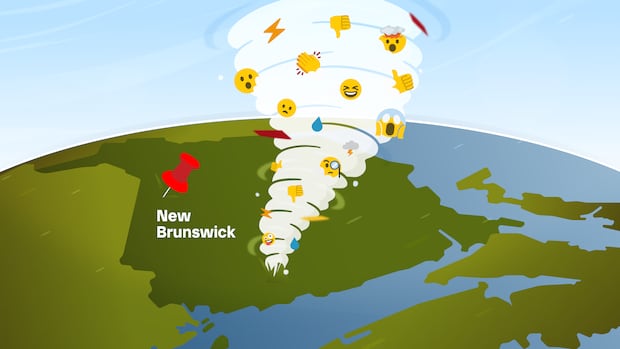
On July 14, Environment Canada issued a severe thunderstorm watch for New Brunswick, indicating favorable conditions for thunderstorm development. The watch also mentioned a potential tornado risk.
Despite no severe storms or tornadoes occurring, social media buzzed with misinformation, unreliable images, and widespread panic. Sander van der Linden, a psychology professor at the University of Cambridge, noted that events like extreme weather attract misinformation due to real-time urgency and uncertainty.
It’s important to differentiate between an Environment Canada “watch” and a “warning.” A watch advises readiness for severe weather, while a warning signals immediate action for ongoing or imminent severe weather.
Jill Maepea, an Environment Canada meteorologist, stated that the tornado risk was low when the severe thunderstorm watch was issued. However, social media had already stirred concern prior to the official watch, with some misinterpreting the information.
Maepea explained that predicting convective weather can be challenging as it can develop rapidly and dissipate quickly. The public criticized Environment Canada for perceived delays in storm notifications, leading to further confusion and misinformation spreading online.
Misleading posts, including AI-generated images, circulated on social media, creating a distorted narrative of the non-eventful storm day. Aaloak Jaswal from the University of New Brunswick highlighted the ease of spreading misinformation with AI technology, emphasizing the need to verify sources in the digital age.
The proliferation of fake images poses risks during emergencies, potentially eroding trust in official communications. Jaswal stressed the importance of discerning real from fake information to maintain public safety.
In emergency situations, the “better safe than sorry” approach may prevail, but continuous exposure to misinformation can undermine trust in genuine alerts. Van der Linden suggested proactive “pre-bunking” to combat misinformation and promote community-led information sharing for a healthier information environment.