
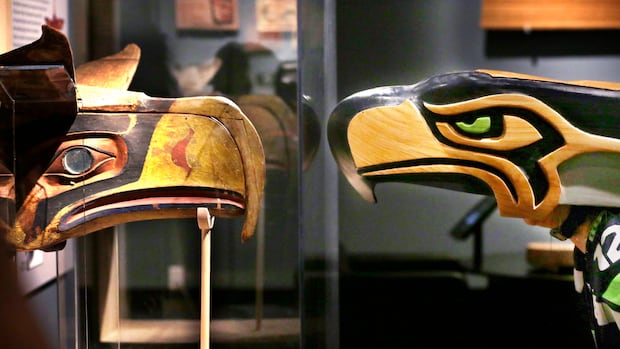
More than ten years ago, during the Seattle Seahawks’ initial back-to-back Super Bowl appearances, students studying art history under Robin K. Wright at the University of Washington began questioning the origins of the NFL team’s emblem. Wright, now a retired professor from the university’s school of art, art history, and design, recalled her students’ peculiar theories, ranging from associating the logo with the Egyptian god Horus to other amusing speculations.
According to Wright, the inspiration behind the team’s logo, featuring a raptor profile, stems from a transformation mask originating from the Kwakwakaʼwakw community in northern Vancouver Island. She mentioned that her colleague Bill Holm, a former curator of Northwest Coast art at the University of Washington’s Burke Museum, had once pointed out the striking resemblance between the logo and a mask depicted in Robert Bruce Inverarity’s 1950 book, “Art of the Northwest Coast Indians.”
Although Seattle is situated on Coast Salish territory, the mask’s origin from the Kwakwakaʼwakw territory might have been overlooked by the designers, as per Wright. She suggested that if the designers had conducted more research and sought an Indigenous design from the Seattle region, they might have opted for a Coast Salish motif. However, during that period, the art style prevalent in the northern Northwest Coast region garnered more public attention.
The Seahawks logo, introduced in 1975 and subsequently refined over the years, has become a recognizable symbol among football enthusiasts worldwide.
Before the Seahawks clinched their first and only Super Bowl victory in 2014, Wright penned a blog post highlighting the potential link between the team’s logo and the Kwakwaka’wakw mask. Initially unaware of the mask’s whereabouts, she speculated it could be in the possession of a private collector, considering the historical prevalence of cultural items ending up with renowned surrealist artists who held a fascination for Indigenous masks.
Eventually, officials from the Hudson Museum at the University of Maine contacted Wright, confirming that the mask was part of their collection. Transformation masks typically showcase dual forms, one when closed and another when open. In this instance, the closed mask depicts a raptor, unfolding to reveal a human face, as explained by Wright. The resemblance to the Seahawks logo wasn’t immediately evident due to the mask’s display method.
Subsequently, the Hudson Museum facilitated the transfer of the mask to the Burke Museum in Seattle for public exhibition. Bruce Alfred, an artist from the ‘Namgis First Nation within the Kwakwaka’wakw territories, visited Washington state to inspect the mask alongside museum officials while wearing gloves.
Alfred, aged 75, affirmed the mask’s Kwakwaka’wakw origin, emphasizing that local artists could readily recognize its distinctive style. Though uncertain of the mask’s exact age, Alfred estimated its creation date to possibly range back to the 1860s or ’70s.
The Seahawks logo encountered criticism shortly after its debut. As per a 1975 Associated Press report, the chairman of the King County Arts Commission expressed concerns to the team owners, noting a lack of sensitivity in depicting the art principles of Northwest Coast Native peoples.
Alfred indicated that there were no consultations with the Kwakwaka’wakw community during the logo’s design phase. He remarked that the logo adoption without consultation signified an honor in incorporating their cultural elements.
Indigenous artists have since reinterpreted the logo, with K’ómoks and Kwakwaka’wakw artist Andy Everson creating his version inspired by a Kwakwaka’wakw mask on southern Salish lands. Furthermore, Coast Salish artist Qualsius crafted a logo version infused with Coast Salish design elements.
In a surreal twist, research by Wright traced the mask’s ownership back to German surrealist artist Max Ernst, who likely acquired it in the 1940s from either a German art dealer or the Museum of the American Indian in New York. A 2024 documentary titled “So Surreal: Behind the Masks” delved into the European surrealists’ fascination with masks from the northwest coast of North America, many of which were obtained through questionable means.
The U’mista Cultural Centre’s website highlights the historical displacement of cherished masks and ceremonial artifacts of the Kwakwaka’wakw, currently held by museums in Canada, England, and the United States due to a past ban on potlatch ceremonies.
Bunn-Marcuse stressed the cultural significance of transformation masks and expressed hope that the association of the mask with the NFL would introduce the intricate history of Northwest Coast art to a wider audience.