
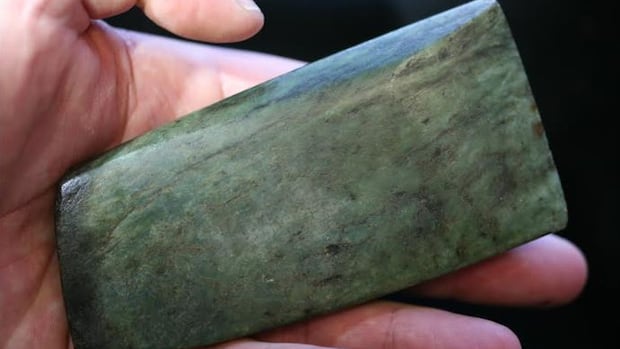
New findings from recent research on jade artifacts discovered east of the Rocky Mountains have revealed insights into the extensive Indigenous trade networks that existed in pre-colonial Western Canada. Over a span of 3,000 years, nephrite jade pieces were meticulously crafted into tools such as blades, chisels, and axe heads by central and coastal Salish communities in the Pacific Northwest. These tools, made from a durable stone with varying colors like emerald green, black, yellow, and white, were crucial for wood carving, a fundamental activity for daily life.
Interestingly, some of these jade tools originated in British Columbia but were found in regions as far as Alberta, Saskatchewan, and Manitoba, indicating long-distance trade routes. The Archaeological Survey of Alberta, based in Edmonton, conducted a study in collaboration with researchers from the University of Alberta, University of British Columbia, University of Saskatchewan, and Royal Saskatchewan Museum. Their investigation focused on stone celts, which were highly valued prestige items in the Prairies.
According to Todd Kristensen, the lead author of the study and regional archaeologist with the Archaeological Survey of Alberta, the distribution of these artifacts suggests the formation of extensive social networks among Indigenous peoples across Western Canada. The jade artifacts were not just functional tools but also served as gifts to strengthen social alliances.
The research aimed to address longstanding questions in anthropology regarding the presence of nephrite artifacts east of the Rockies. Through advanced testing methods like portable X-ray fluorescence and gamma spectrometry, the study confirmed that all 24 examined jade celts originated from the Fraser River region in British Columbia. The findings revealed that these artifacts traveled an average distance of nearly 850 kilometers, with some covering up to 1,500 kilometers.
Possible trade routes were suggested in the study, indicating interactions between Interior Salish craftspeople and Dene groups, as well as trade fairs on the Fraser River involving Dene communities from northern Alberta. The labor-intensive process of crafting a nephrite celt, taking up to 500 hours for larger pieces, highlighted the significant value and meaning attached to these objects.
The study emphasized the cultural and social significance of the jade artifacts, showcasing the intricate relationships and trade networks that connected Indigenous communities across Western Canada. Kisha Supernant, director of the Institute of Prairie and Indigenous Archaeology at the University of Alberta, commended the research for highlighting these human connections and challenging misconceptions about pre-contact Indigenous groups. The study also underscored the importance of engaging with Indigenous communities and incorporating traditional oral histories into archaeological research for a comprehensive understanding of the past.