
In ancient Greece, pigeons were utilized to deliver Olympic game results, act as messengers during wartime, and even smuggle drugs into prisons. Now, in Vancouver, researchers have enlisted pigeons to aid in the development of more intelligent drones.
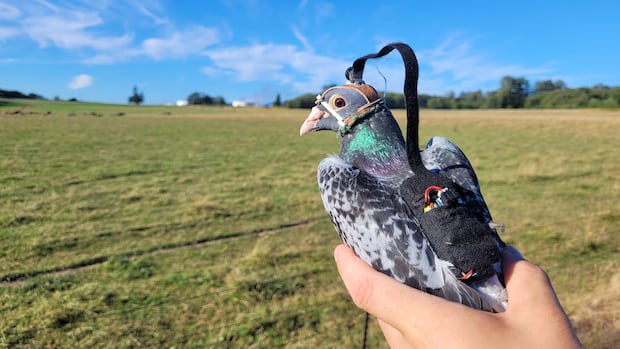
A study led by the University of British Columbia, detailed in Current Biology, involved equipping homing pigeons with miniature backpacks containing a small computer and head-mounted cameras to monitor their eye movements while flying. The setup, weighing approximately 27 grams, included a credit card-sized computer, a modified commercial camera, and sensors tracking the birds’ movements and orientation.
Anthony Lapsansky, the lead researcher, described the meticulous process of fitting the equipment onto the pigeons, requiring considerable effort and experimentation. By gradually introducing the gear to the birds using mock backpacks, designed to acclimate them over several weeks, the team successfully trained a flock of about 16 pigeons to fly along a familiar route for data collection.
The study revealed that pigeons exhibit slow, subtle eye movements during flight, potentially allowing them to gather detailed visual information. Contrary to previous assumptions that birds maintain fixed eye positions while airborne, the research demonstrated that pigeons actively adjust their gaze, even converging both eyes while landing to assess depth perception, akin to human visual processing.
David Bird, a wildlife biology professor at McGill University not involved in the study, noted the study’s challenge to traditional beliefs about avian vision. He highlighted the contrast with a recent California Institute of Technology study, emphasizing the importance of flight altitude and surrounding environment in determining eye movement patterns.
The insights gained from studying pigeon vision could revolutionize drone technology. Lapsansky proposed that mimicking birds’ dynamic eye movements could enhance drones’ capabilities in navigation and environmental perception. Bird, drawing from his drone expertise, endorsed the potential for more agile cameras to improve drone performance significantly.
Incorporating adaptable visual systems inspired by pigeons could usher in a new era of drone technology, surpassing the current limitations of fixed cameras and sensors. As drones continue to evolve, insights from avian research may pave the way for more efficient and versatile aerial systems.