
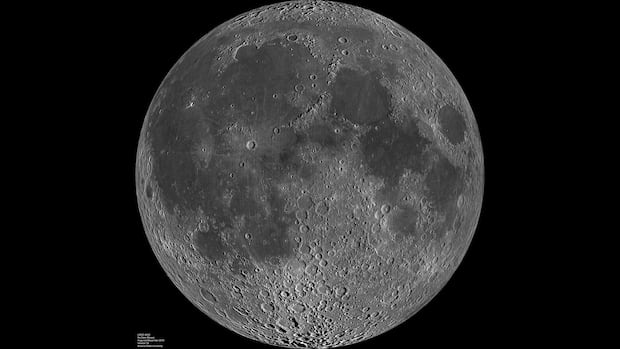
In the early hours of Wednesday, telescopes worldwide will aim to capture a unique event: an old rocket crashing into the moon’s illuminated side. The rocket’s second stage belonged to a SpaceX Falcon 9 that launched in January 2025, carrying two commercial lunar landers: Firefly Blue Ghost-1 from the U.S. and ispace Hakuto-R Resilience from Japan. Independent astronomer Bill Gray, who tracks objects in space, predicted this collision last September after meticulously calculating the orbital dynamics affected by the moon, Earth, and the sun. As the impact date of August 5, 2026, approaches, Gray is fine-tuning the trajectory for an accurate prediction of when and where the rocket will hit the moon.
This upcoming event isn’t the first time a human-made object will crash into the moon. Previous impacts include Apollo upper stages and intentionally smashed objects, with the aim of studying potential outcomes like water or ice presence and altering orbits. Notable impacts like NASA’s Lunar Crater Observation and Sensing Satellite and ESA’s SMART-1 spacecraft have left significant marks on the lunar surface, highlighting the interest in understanding such events.
Astronomers are gearing up to witness and study this impact, anticipating the ejection of rock and dust into space as the rocket collides with the moon at a speed of approximately 2.43 kilometers per second. Observations following the impact will provide crucial insights into the debris dispersion and potential risks posed by such events. The precise timing of the impact at 2:34:32.9 a.m. ET on August 5, 2026, offers a prime viewing opportunity for observers in central and eastern Canada, the U.S., the Caribbean, and parts of South America due to the favorable position of the moon above the horizon.
The scientific community hopes to gain valuable data from this impact to assess the risks posed by artificial collisions on the moon, especially with the prospect of increased human activity on its surface. Understanding the direct and indirect hazards of such impacts is crucial for future lunar missions. While the chances of an astronaut being hit remain slim, the event will shed light on potential risks, including the consequences of debris falling back onto the lunar surface. As astronomers prepare to capture this significant event, the focus remains on studying the impact’s implications and enhancing our understanding of space hazards.