
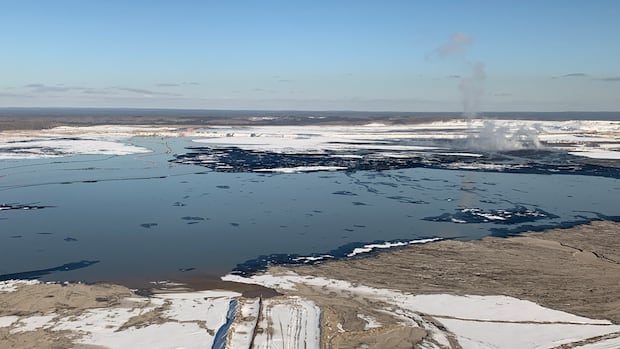
Some Indigenous leaders are seeking clarification from the Canadian government following the signing of a pipeline agreement with Alberta that overlooks the issue of freshwater. The agreement, aimed at potentially constructing a pipeline for bitumen transportation from Alberta to the British Columbia coast, does not address the substantial water usage necessary for extracting bitumen from the oilsands. Additionally, it fails to acknowledge the risks to freshwater sources posed by the residual tailings ponds left by oilsands operations.
The Crown-Indigenous Working Group was established by the federal government in 2021 to collaborate with affected Indigenous communities and Métis groups in developing strategies to manage and remediate the heavily polluted tailings ponds.
The Privy Council Office did not provide a direct response when questioned about the omission of water considerations in the Alberta agreement. Instead, it reiterated the commitment of the Major Projects Office to engage with Indigenous communities and uphold the United Nations Declaration on the Rights of Indigenous Peoples.
An Indigenous water watchdog’s recent report projected that by 2070, tailings ponds in Alberta could expand to a size larger than neighboring First Nations territories. This expansion poses a significant risk to water resources and the treaty rights of Indigenous communities who have long protected these waters.
The federal-provincial agreement was signed shortly before Indigenous Services Minister Mandy Gull-Masty refrained from guaranteeing the inclusion of source water protections in a forthcoming legislation addressing clean drinking water for First Nations. The previous version of this bill, introduced under former Prime Minister Justin Trudeau’s government, did include source water protection but was not enacted before Parliament was prorogued.
Provincial governments in Alberta and Ontario opposed the legislation, expressing concerns about its potential impacts on development. In contrast, First Nations leaders urged Minister Gull-Masty not to yield to provincial pressures.
Notably, the only reference to water in the Alberta agreement pertains to the potential route of a pipeline to the Pacific coast. The agreement implies that exporting bitumen through a deepwater port in British Columbia for Asian markets might necessitate lifting the oil tanker moratorium in effect since 2019.
Coastal First Nations president Marilyn Slett emphasized the critical importance of maintaining the oil tanker moratorium during discussions with Prime Minister Mark Carney, highlighting the severe consequences a single oil spill could have on their way of life.
Indigenous leaders in Alberta are particularly alarmed by the history of leaks from tailings ponds contaminating their water sources. Grand Chief Trevor Mercredi of Treaty 8 First Nations in Alberta expressed doubts about the current prioritization of environmental protections and water safety by both the government and industry stakeholders.
Jesse Cardinal, executive director of Keepers of the Water, emphasized the pressing need to balance the government’s energy ambitions with the finite water resources available. Cardinal underlined the unsustainable nature of current water consumption levels, impacting not only Indigenous communities but also farmers reliant on irrigation and all Albertans concerned about environmental safety.
The federal government has allocated $12 million over a decade for the Fort Chipewyan Health Study to evaluate the health effects of oilsands activities on community members. This study aims to ascertain potential heightened risks of cancer and other health issues in communities downstream of the oilsands operations, as Indigenous communities along the Athabasca River have reported elevated cancer rates.
Mikisew Cree First Nation and Keepers of the Water have persistently raised concerns about the lack of progress in addressing tailings ponds and their environmental impacts. They plan to convene a conference to discuss these issues and have invited Prime Minister Carney to participate.
A discussion paper on tailings pond management, jointly developed by Environment and Climate Change Canada and the Crown-Indigenous Working Group, was released in February. The paper emphasizes a commitment to thoroughly assess and mitigate any impacts on treaty and Aboriginal rights resulting from potential effluent releases from oilsands mining.
Indigenous leaders stress the necessity of conserving water resources and fostering collaboration to address the environmental challenges posed by ongoing industrial activities. They urge a holistic approach that safeguards both the environment and community well-being while promoting sustainable development practices.