
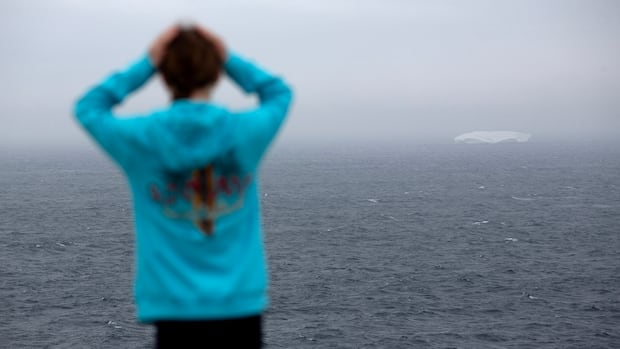
At the summit of Signal Hill in St. John’s on a sunny Tuesday afternoon, a continuous flow of individuals strolled along a rugged cliff and marveled at the sight before them. Some expressed excitement, while others whipped out their smartphones to capture the moment – a surge of wonderment as an iceberg drifted in the ocean below, detached from a glacier in Greenland and carried by the Labrador current.
This year is proving to be exceptional for icebergs in Newfoundland and Labrador, drawing tourists and locals to shorelines throughout the province to greet these age-old visitors. Susan Davis, a visitor from Baltimore, described the experience as “joyous” and “beautiful,” praising the intense and wonderful colors of the icebergs.
The annual procession of icebergs during spring is predominantly a feature of Newfoundland and Labrador, with this year witnessing nearly double the usual number of icebergs. Satellite data as of Wednesday afternoon indicated close to 520 icebergs off the eastern coast of Newfoundland and southern Labrador, revealed George Karaganis, a senior meteorologist at the Canadian Ice Service.
Conditions conducive to a robust iceberg season evolve over years, beginning in Greenland where glaciers over 10,000 years old begin to calve. These ice fragments can journey for up to three years before reaching Newfoundland and Labrador, propelled by the Labrador current past Baffin Island and through the Labrador Sea. If spring winds blow vigorously from the northeast, the icebergs are pushed closer to the shores of Newfoundland and Labrador for public viewing.
While favorable conditions aligned this year, experts anticipate a decline in iceberg numbers due to climate change. Sea ice acts as a shield, preventing icebergs from melting before they reach Newfoundland and Labrador. However, with diminishing sea ice concentrations attributed to warming waters, the protection for icebergs is expected to diminish, as explained by Pradeep Bobby, who heads the Earth observation team at C-CORE in St. John’s.
Pat Bridger, a resident of Twillingate, N.L., woke up to the sight of an iceberg floating outside her sewing room window on Tuesday morning, which was joined by another on Wednesday. Twillingate, known as the iceberg capital of the world, experiences a thriving iceberg tourism season. Bridger, accustomed to such sightings, still finds them special and eagerly captures photos from various angles, hoping to capture glimpses of gold and silver in the sunlight.
Alick Tsui, a photographer based in St. John’s, was delighted as he observed two icebergs off the coast while monitoring an eagle’s nest ready to hatch via video call with The Canadian Press. Tsui had recently embarked on a tour boat to get a closer look at one of the icebergs, describing the unique colors and sparkles that can only be appreciated from the water.
Even the interiors of icebergs hold unique characteristics, according to Davis, who mentioned receiving iceberg chunks from her tour boat guide. Taking a bite, she was surprised by the hardness of the ice crystals, contrasting with the solidity of a typical ice cube. She marveled at the fact that the ice was 15,000 years old, finding it incredible to consume a piece of ice with such ancient origins.
The remarkable influx of icebergs has captivated residents and visitors alike, offering a rare spectacle that may diminish in the future due to changing environmental conditions.