

One incident occurred during a global conflict, while the other took place amid a worldwide health crisis.
Both heat waves triggered wildfires, resulted in the deaths of hundreds, and serve as warnings about what researchers predict will become more frequent occurrences in a warming planet.
However, only one of these events – the heat dome of 2021 – has been thoroughly investigated, as noted by Simon Fraser University researchers Sam Anderson and Shawn Chartrand in an article published in the journal Communications Earth & Environment.
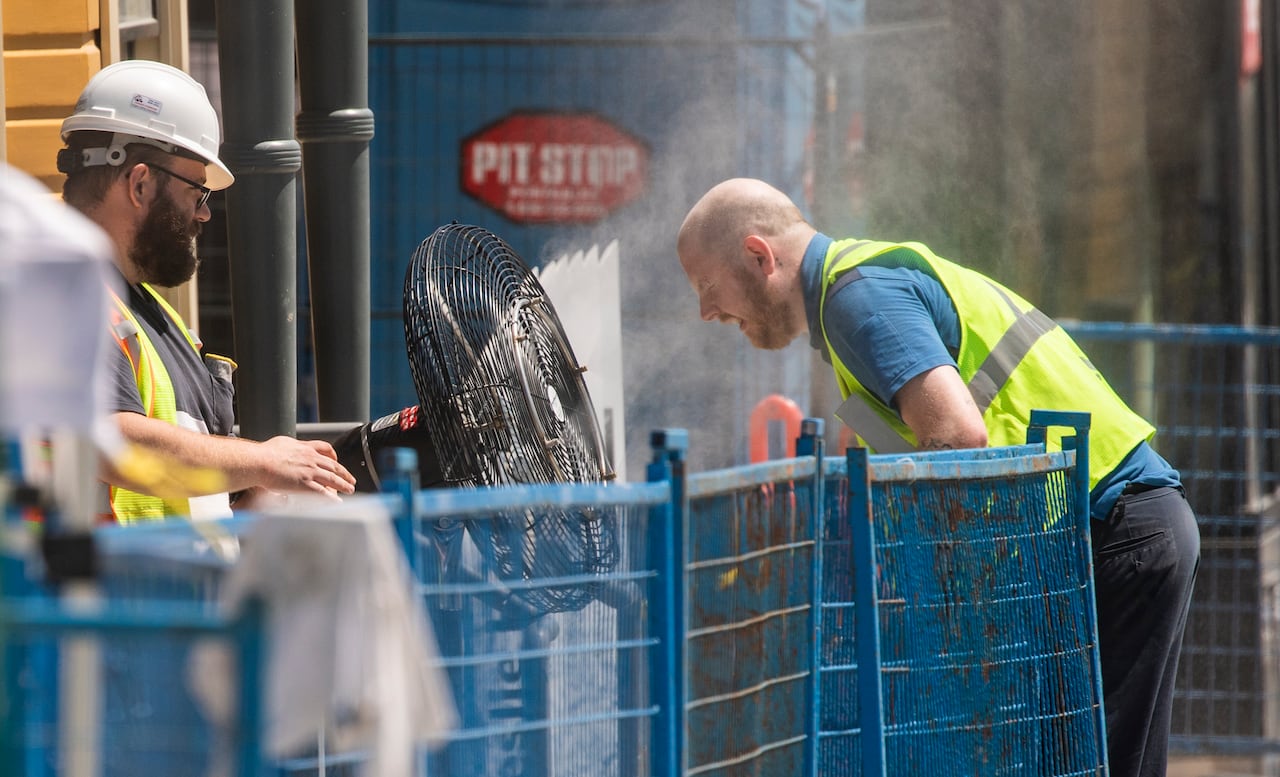
A construction worker utilizes a misting fan to cool off at a job site in Vancouver during the heat dome of 2021. (Ben Nelms/CBC)
The researchers analyzed newspaper reports and scrutinized historical climate and mortality statistics to compile as much data as possible regarding the North American heat wave of 1941.
“It’s essentially the only contemporary known comparison to the record-breaking heat wave of 2021,” Anderson remarked in an interview.
“The 2021 heat wave created a cohesive narrative that helps explain how such extreme temperatures affect a variety of physical and social systems in the impacted area; the 1941 heat wave now offers an additional perspective for comparison,” the authors stated.
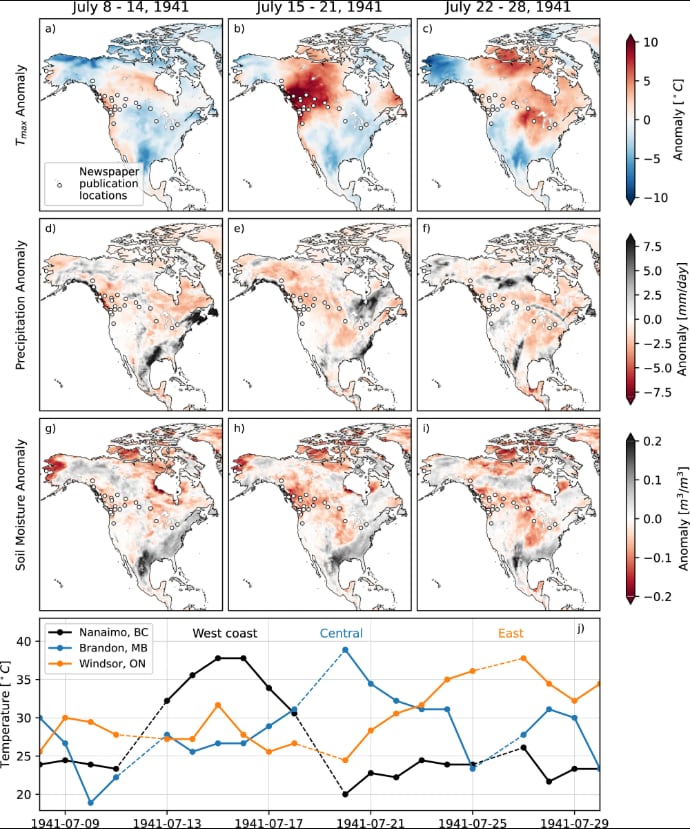
An overview of temperature, precipitation, and soil moisture from July 8 to 28, 1941. (Sam Anderson & Shawn M. Chartrand)
Between July 13 and 18, 1941, regions in Washington, Oregon, British Columbia, and southeastern Alaska endured an extended stretch of extreme heat, according to the researchers.
In Nanaimo, temperatures surpassed 32°C for six consecutive days, while Lillooet recorded the highest temperature in the province at 44.4°C, a record that was only exceeded in 2021 when Lytton reached 49.6°C.
Unlike in 2021, when the heat wave’s impact was primarily felt on the western side of North America, the 1941 heat wave severely affected both central and eastern regions of the continent. In fact, the majority of fatalities associated with the 1941 heat wave — 305 out of 344 — occurred in the eastern United States, the researchers reported.
The B.C. Coroners Service linked 619 deaths to the 2021 heat dome.
“In some respects, the fact that the heat dome of 2021 did not extend to the east may have spared us from an even greater number of fatalities,” Anderson stated in the article.
Michael Brauer, a professor at the University of British Columbia’s School of Population and Public Health, who was not part of the study, suggests that the 2021 incident may not have been as devastating due to the prevalence of air conditioning in the eastern regions.
“We’re somewhat isolated in the Pacific Northwest in terms of the rest of the continent, as air conditioning has not been historically required in our climate,” he explained.
A significant distinction between the two heat waves was the demographics of the victims and their causes of death. In 1941, a majority of fatalities resulted from outdoor labor, particularly among workers, as noted by the researchers. Drowning was a common indirect cause of death, as individuals sought relief from the heat.
In contrast, most of the individuals who died in 2021 were older, had pre-existing health issues, and succumbed indoors, according to the B.C. Coroners Service.
This trend can be attributed to increased life expectancy and the heightened vulnerability of older adults to heat, as they struggle to regulate their body temperature, Brauer noted.

Professor Michael Brauer from the University of British Columbia School of Population and Public Health. (Michael Brauer)
Another similarity between the two heat domes was the occurrence of wildfires, although they unfolded differently, as reported by the researchers.
On the night of July 17, 1941, extensive thunderstorms ignited numerous wildfires, encircling Vancouver with blazes to the north, east, and south.
Fortunately, cooler weather extinguished these fires relatively quickly, while the wildfires in the B.C. Interior during 2021 continued and ultimately destroyed the town of Lytton.
“The takeaway here is to recognize that the climate challenges faced by smaller communities in B.C. are also threats to larger urban areas, and we shouldn’t assume that living in major cities makes us immune to the effects of climate change,” Anderson concluded.