
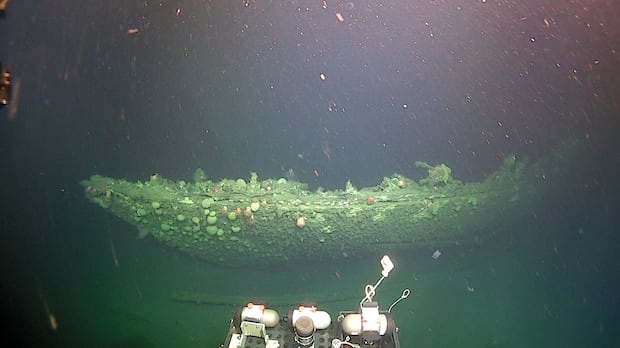
After spending 80 years at the bottom of the Labrador Sea, the Terra Nova, which once carried famous British explorer Robert Falcon Scott to the South Pole, has undergone significant changes. Described as a wreck in poor condition but intriguing, the ship was examined by David Mearns, the co-chief scientist of a Canadian-led expedition aimed at documenting the vessel. Although the ship was initially discovered in 2012 off the coast of Greenland, this recent scientific mission marks the first detailed imaging endeavor.
This expedition, led by the Royal Canadian Geographical Society, has now turned its attention to a second shipwreck, the Quest, which transported renowned explorer Sir Ernest Shackleton on his final journey to Antarctica. Utilizing remotely operated vehicles (ROVs) and an underwater submersible, the team began studying the Quest’s wreckage about a week ago.
Employing cutting-edge Canadian technology, the research team aboard the Atlantis research vessel employed an ROV to map the Terra Nova wreck, which was launched in 1884 before its fateful voyage with Scott in 1910. The ship now lies at a depth of 170 meters and approximately 30 kilometers south of Greenland, revealing visible remnants such as the ship’s double wheels, rudder, boilers, and steam winches.
The technology developed by Voyis, based in Waterloo, Ontario, not only captures images and videos but also creates comprehensive three-dimensional maps of the entire ship. Marine biologist Kirstin Meyer-Kaiser emphasized the significance of the 3D model, which provides a contextual framework for research and facilitates a deeper understanding of the marine environment surrounding the wreck.
Dwight Coleman, the expedition’s other co-chief scientist and director of ocean imaging at the Woods Hole Oceanographic Institution in Massachusetts, highlighted the advancements in technology that have streamlined the imaging process. By eliminating the need to manually stitch together numerous photos, the team can now generate a comprehensive overview of the ship.
Furthermore, Meyer-Kaiser’s research delves into the ecological impact of shipwrecks on marine life, particularly the Terra Nova’s role as a habitat for fish. She aims to analyze the consequences of human-made objects, such as shipwrecks, on ocean ecosystems and draw parallels to modern infrastructure like oil platforms and bridges.
John Geiger, president of the Royal Canadian Geographical Society, reflected on the significance of exploring the Terra Nova and Quest, vessels that symbolize a pivotal era in exploration history. As the expedition leverages state-of-the-art ocean technology to document these iconic ships more than a century after their expeditions, Geiger emphasized the importance of learning from the experiences of past explorers in a rapidly evolving world.