
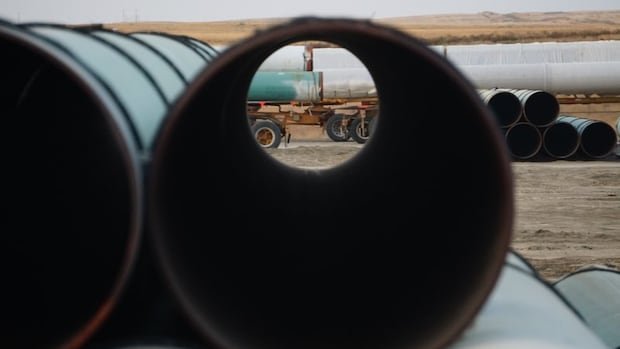
A plan spearheaded by South Bow, a Canadian company, aims to rejuvenate sections of the previously halted Keystone XL oil pipeline, potentially boosting Canada’s crude exports to the U.S. by over 12%. This initiative hinges on approval from U.S. President Donald Trump and the construction of additional connections to American refining centers.
The proposed route diverges from the original Keystone XL pipeline path, which was scrapped by former U.S. President Joe Biden in 2021 following opposition from Indigenous groups and environmental activists. South Bow, a company established by TC Energy in 2024 to manage its oil pipeline operations, is exploring the revival of a portion of the pipeline already constructed in Alberta, holding all necessary Canadian permits.
During a discussion with Trump in October, Canadian Prime Minister Mark Carney broached the topic of reviving the pipeline, which could influence negotiations concerning the renewal of the Canada-U.S.-Mexico trade agreement. Trump, known for advocating lower oil prices, has emphasized the significance of Canadian oil exports to U.S. refiners, who rely on approximately 4.4 million barrels per day from Canada.
Bridger Pipeline, a potential U.S. partner for South Bow, has submitted a proposal to Montana regulators for a 1,038-kilometer pipeline capable of transporting up to 550,000 barrels per day. This pipeline would originate near the U.S.-Canada border in Phillips County, Montana, and extend to Guernsey, Wyoming. However, analysts note that additional infrastructure links are essential to transport the oil to key refining hubs such as Cushing, Oklahoma; Patoka, Illinois; and the U.S. Gulf Coast.
Leading energy analyst Matthew Lewis suggests that the most viable configuration entails constructing a new pipeline spanning over 680 kilometers from Guernsey to Steele City, Nebraska, integrating with the existing Keystone mainline system. Despite the potential benefits, uncertainties exist regarding the willingness of stakeholders to undertake the associated risks, including permitting challenges and environmental litigations.
While South Bow envisions connecting its proposal to downstream U.S. pipelines, the company refrained from elaborating further. Bridger Pipeline also chose not to comment on the matter.
Bridger’s strategy involves aligning the Montana-to-Guernsey segment with existing pipeline infrastructure, which could streamline the permit acquisition process. On the Canadian side, around 150 kilometers of Keystone XL pipeline have already been constructed and remain inactive since the project’s cancellation.
The White House declined to comment on the South Bow-Bridger proposal, emphasizing the need for a presidential permit for the segment crossing the U.S.-Canada border. Analysts caution that while the current administration may support the plan, future administrations could pose challenges, underscoring the political uncertainties inherent in multi-year projects spanning different governance regimes.
Despite its divergence from the original Keystone XL, the proposed project represents a substantial pipeline expansion likely to encounter opposition from environmentalists, landowners, and Indigenous communities. Given the history of pipeline projects facing cancellations and legal hurdles in the U.S., the initiative is poised to trigger contentious debates and regulatory scrutiny across administrations.
Simultaneously, Trans Mountain, the company behind the Alberta-to-west coast pipeline, is planning enhancements to increase capacity by 360,000 barrels per day. Enbridge, a rival of South Bow, has already greenlit expansion projects for its Flanagan and Mainline pipeline systems, adding a combined 250,000 barrels per day capacity for Canadian heavy oil shippers. These projects are deemed less complex and more economically viable compared to South Bow’s proposal, raising concerns about the latter’s financial sustainability and debt management among investors.