
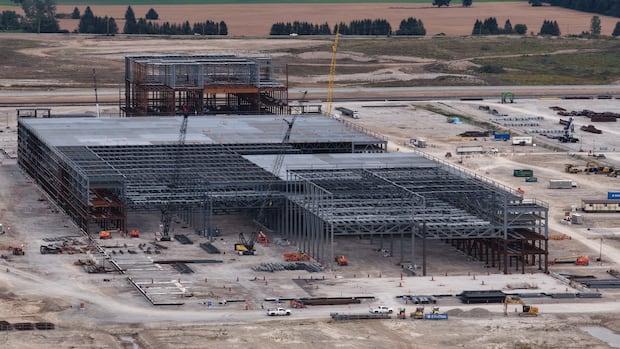
The Canadian federal and provincial governments made significant investments in the electric vehicle (EV) industry, but major EV and battery projects in Ontario, Quebec, and British Columbia have faced delays, cancellations, suspensions, substantial changes, and even bankruptcy due to lower-than-expected demand. The most recent setback involves Volkswagen’s PowerCo battery plant in St. Thomas, Ontario, which has pushed back production to 2029 due to evolving market demand.
Critics question whether Canada overestimated the growth pace of the EV market. Some argue that the demand may not meet the necessary levels to support the envisioned battery production scale, while others view these setbacks as temporary hurdles in the long-term shift towards electrification.
Grieg Mordue, a former Toyota executive and retired McMaster University professor, highlights two key issues with Canada’s EV investment strategy concerning scale and location. The St. Thomas plant initially aimed to produce enough battery cells for approximately one million EVs annually, but Mordue suggests inefficiency due to the plant’s geographical distance from Volkswagen’s major assembly operations in the southern United States and Mexico.
Volkswagen’s North American plants do not currently produce enough vehicles to accommodate the production of a million batteries each year. The company’s decision to delay production until 2029 is seen as an opportunity to incorporate newer battery technology and align production with evolving demand.
The investments in EV and battery manufacturing are viewed as crucial for Canada’s competitiveness in the global auto industry’s shift towards electric vehicles. Despite current challenges, there are positive signs of recovery in Canada’s EV market, with an increase in new registrations of battery-only EVs and zero-emission vehicles.
The long-term view suggests that the current slowdown is part of the industry’s transition and not an indicator of excessive battery capacity in Canada. The domestic production of batteries is essential not only for electric vehicles but also for grid-scale storage as electricity grids expand.
While uncertainties remain, the early investments in EV batteries are seen as strategic moves to secure Canada’s position in the evolving automotive landscape. The broader justification for building domestic battery capacity remains valid, especially given the global concentration of battery cell production in Asia.
University of Guelph economics professor Ross McKitrick expresses concerns about the mismatch between policy expectations and actual market demand for EVs. Governments’ efforts to stimulate the EV market through incentives and subsidies may not be sufficient to drive the anticipated demand.
The article also mentions the government’s recent actions, such as scrapping EV sales requirements and proposing new emissions standards, reflecting the evolving regulatory landscape for electric vehicles in Canada. Despite ongoing challenges, the investments in EV and battery manufacturing are crucial for Canada’s future competitiveness in the auto industry.