
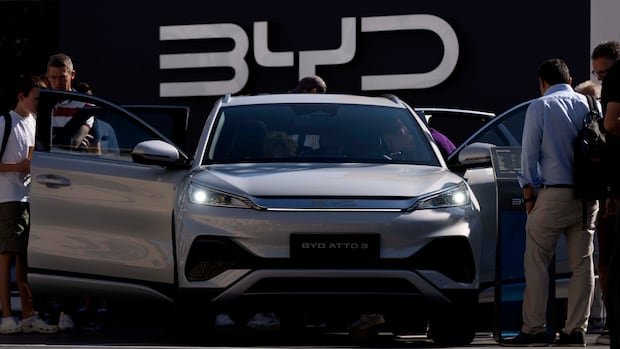
Canada is aiming to collaborate with Chinese companies over the next three years to develop an electric vehicle (EV) using Chinese expertise, a senior Canadian official revealed. The objective is for Canada to lead North America in producing this type of EV.
The official stressed that assuming U.S. President Donald Trump would block Chinese EVs from entering the U.S. is a misconception. Canada informed the Trump administration in advance of its decision to permit up to 49,000 Chinese EVs into the Canadian market annually at a reduced tariff of 6.1% from the previously imposed 100% tariff set for 2024.
Canada’s ambassador to the U.S., Kirsten Hillman, was briefed on discussions with Beijing, ensuring U.S. Trade Representative Jamieson Greer was informed following a meeting between Prime Minister Mark Carney and Chinese President Xi Jinping. The American response was reportedly neutral.
The official stated that there were no surprises for the U.S. regarding Canada’s deviation from matching American tariffs on Chinese EVs. Trump commended Carney for signing the trade deal, emphasizing the importance of making agreements with China.
However, concerns were raised by officials in Washington, with Greer describing the deal as “problematic for Canada.” U.S. Transportation Secretary Sean Duffy expressed apprehension that Canada might regret allowing Chinese cars into its market.
The Canadian government is crafting an auto policy set for release in February to support the growth of Canada’s auto industry, which currently employs 125,000 workers. The government aims to surpass the U.S. auto sector through strategic policy measures.
Trump has emphasized that the U.S. does not rely on cars manufactured in Canada, imposing tariffs on Canadian-made vehicles. The president has urged auto manufacturers to relocate operations to the U.S. to evade tariffs.
Industry Minister Mélanie Joly recently announced serving automotive giant Stellantis with a notice of default under funding contracts related to projects in Windsor and Brampton, Ontario, after the company decided to shift production from Canada to the U.S.
The government plans to offer preferential treatment to foreign automakers producing vehicles in Canada compared to those importing cars assembled overseas. Foreign automakers not manufacturing vehicles locally will face less favorable terms, according to the official.
Carney highlighted that the deal with China would lower the cost of some EVs for Canadians and have a marginal impact on the domestic market, accounting for approximately three percent of sales.