
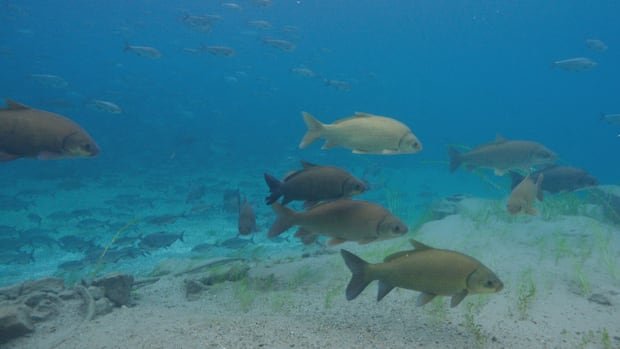
A recent documentary showcased captivating underwater scenes in Lake Huron, where an area was dubbed “fish city” due to its abundant marine life. However, the Saugeen Ojibway Nation (SON) challenges this perception, labeling the site as a “fish trap” near the warm-water outflow of the Bruce Nuclear Generating Station.
SON highlights a significant event in 2025, where up to five million gizzard shad perished near the nuclear plant, as reported by the Department of Fisheries and Oceans (DFO) in a Canadian Nuclear Safety Commission regulatory document. This massive fish die-off resulted in the clogging of cooling water intake systems, leading to the shutdown of Bruce A Unit 2.
Furthermore, SON mentions the plight of several lake sturgeon, a culturally significant species at risk according to Anishnaabe teachings, that became stranded in a pond at the plant. While one sturgeon was rescued, three others remain in the forebay pond.
The debate over the “fish city” designation extends beyond mere visuals, raising concerns about how Bruce Power manages environmental risks. The company seeks regulatory approval to boost plant limits for enhanced electricity output from its reactors.
SON argues that the warm water discharge from the Bruce Nuclear Generating Station acts as a lure for fish, eventually trapping them within the facility. While regulators did not directly attribute the fish deaths to the plant, a biologist from SON suggests a dual-stage process of attraction and entrapment operating at the site.
In response, Bruce Power refutes claims of causing the 2025 fish die-off, attributing it to unusual environmental conditions. The company has implemented various deterrent measures and monitoring systems to prevent fish from entering its intake systems.
Despite these efforts, concerns remain regarding the lack of clear benchmarks for assessing fish mortality due to plant operations. This uncertainty underscores the ongoing challenge of balancing energy production with environmental protection.
The importance of gizzard shad in the lake ecosystem is emphasized by community members like Paul Jones, highlighting the ecological and cultural significance of fish populations. Jones stresses the need for a holistic approach to address the impact of fish deaths on the ecosystem and indigenous traditions.