
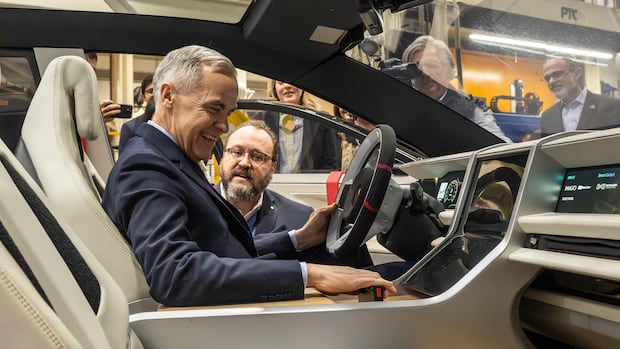
Prime Minister Mark Carney has decided to revoke Canada’s electric vehicle mandate that mandated all new car sales to be electric within a decade, eliminating another environmental policy established during the Trudeau era.
Instead of the previous mandate, Carney is implementing stricter greenhouse gas emission standards for vehicle models from 2027 to 2032. This move aims to incentivize automakers to increase the production of zero-emission vehicles.
Speaking at a news conference at an auto parts manufacturer in the Greater Toronto Area, Carney stated, “Canada will forge a new, more ambitious path to reduce automobile emissions.” He emphasized that the government is doubling down on GHG emissions standards and providing the industry with flexibility in meeting these standards, whether through plug-in hybrids, electric vehicles, or more fuel-efficient internal combustion engine vehicles.
The government unveiled a new national automotive strategy to safeguard Canada’s auto sector and jobs amid U.S. President Donald Trump’s efforts to relocate vehicle production to the south. Additionally, Ottawa aims to revitalize the country’s battery-powered vehicle industry.
Carney anticipates that under the new emissions system, electric cars will constitute 75% of new car sales in Canada by 2035, a challenging objective albeit lower than the previous mandate he is abandoning. Although precise calculations on the carbon pollution reduction from the new system are not available, Carney mentioned a 57% reduction in emissions based on “grams per mile.”
Furthermore, the Liberal government introduced a $2.3 billion program to provide consumers and businesses with purchase or lease incentives of up to $5,000 for electric vehicles and up to $2,500 for plug-in hybrids. To qualify for rebates, plug-in vehicles must be priced under $50,000 and manufactured in countries with which Canada has free trade agreements, excluding vehicles from China.
The rebates of $5,000 and $2,500 will be available for 2026 only, gradually decreasing from the following year until the program’s scheduled conclusion after 2030. Previously, Canada offered rebates of up to $5,000 to consumers to reduce the cost of plug-in vehicles, but the program exhausted its funds over a year ago due to high demand.
The government also plans to collaborate to expand the network of EV charging stations nationwide. Carney emphasized the need for a $1.5 billion fund to address concerns about reliable charging infrastructure, particularly in rural and northern communities. Additionally, a new electricity strategy is set to be released soon to double Canada’s grid capacity and enhance electricity reliability and affordability.
In a bid to retain automakers in Canada and prevent them from relocating, Ottawa intends to provide more tariff relief to Canadian automakers facing U.S. tariffs. Carney highlighted that if the U.S. imposes auto tariffs during the CUSMA review, the government is contemplating rewarding companies selling vehicles in Canada.
Moreover, an additional $3 billion from the Strategic Response Fund and up to $100 million from the Regional Tariff Response initiative will be allocated to support the auto sector in diversifying to non-U.S. markets and fostering growth.
Carney’s decision to scrap the EV mandate is the latest in a series of environmental policy changes from the Trudeau era. Carney has also revoked the consumer carbon tax, weakened commitments on oil and gas emissions caps, and abandoned Trudeau’s pledge to plant two billion trees.
Ontario Premier Doug Ford expressed support for the federal government’s new auto strategy, stating that ending the electric vehicle mandate will enhance the competitiveness of the auto sector in Ontario. The federal government’s initiative comes at a time when electric vehicle sales are declining, influenced by factors such as paused rebate programs, economic uncertainties, and waning interest in electric vehicle manufacturer Tesla.
Overall, the government’s efforts aim to strengthen the automotive sector, encourage the adoption of electric vehicles, and create a more sustainable and competitive industry landscape.