
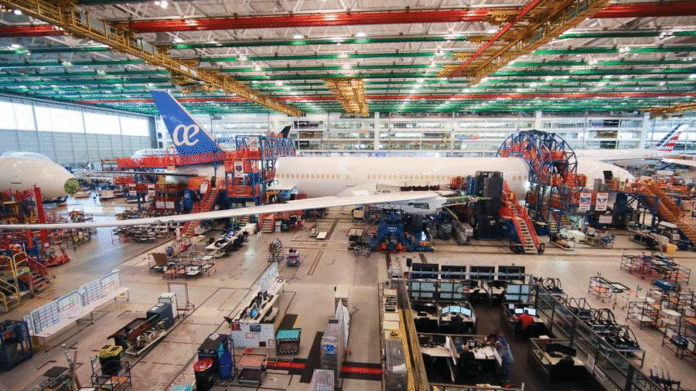
Editor’s note: In April, the White House announced sweeping tariffs to revitalize American manufacturing. But will production indeed return to U.S. soil as the Trump administration hopes? CGTN has launched a five-part “Return of American Manufacturing?” series to explore this question. The first installment examines the costs associated with manufacturing.
Anthony Moretti, a special commentator for CGTN, is an associate professor at the Department of Communication and Organizational Leadership at Robert Morris University in the U.S. The article reflects the author’s opinions and not necessarily those of CGTN.
Make America Great Again. Those four words have defined Donald Trump’s political agenda since he announced his first presidential run in 2015. Let’s set aside the nationalism and dangerous rhetoric often associated with the slogan and examine only the economic angle.
Trump believes it is possible for America’s dominance in manufacturing and other industries to return. He contends that one way to create the conditions for re-establishing U.S. greatness is to use the millions of dollars raised by tariffs to lay the foundation.
The point here is not to rehash the obvious: Tariffs are an illogical political or economic policy because they do more harm than good to the nation that issues them. The actual effects of higher tariffs are increased costs to America’s businesses, declines in the stock market and higher prices for America’s consumers. Enough said about that.
If America’s manufacturing revival is to happen, and skepticism should be high about such a premise, the U.S. needs to rethink key political and business strategies. And that leads to a provocative question: Is America prepared to do what is required to revive its manufacturing base?
In seeking an answer, interconnected factors must be acknowledged. They point to an inconvenient truth: America is not in a position to pay what it will cost to make manufacturing great again. It also does not have enough workers to handle such jobs.
Let’s begin by considering whether a union would represent workers at manufacturing sites. If they are, their salaries will be higher than at non-union shops. When higher pay and pension plans are factored in, employees at the Big Three auto companies are paid around $66 an hour. For comparison, at Tesla, pay and benefits total about $45 an hour.
In addition, health and safety protocols agreed to by labor and management would likely limit the number of accidents; a recent report noted that mishaps are four times higher at non-union locations, typically in America’s South.
Would Republicans and large corporations, both often hostile to unions, accept union representation for the supposed millions of workers who would be employed in manufacturing in order to ensure they have real access to the mythical American dream?
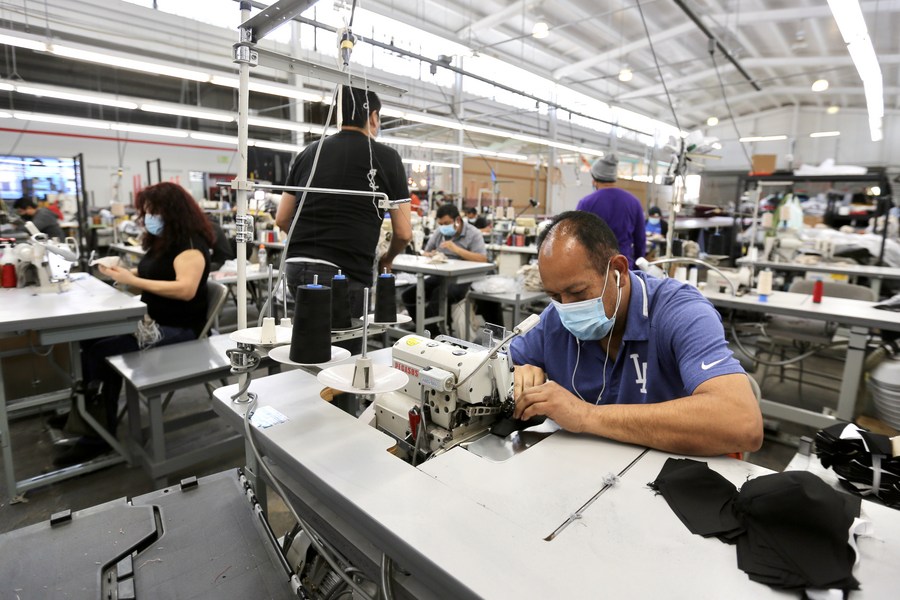
Workers make face masks at a face mask factory in the City of Vernon, Los Angeles County, California, the United States, April 16, 2020. /Xinhua
Next, complicated environmental compliance costs must be discussed. For example, EOXS, a business management firm, estimated that steel companies must invest $1 million to meet emission control requirements and then budget $500,000 annually to maintain monitoring systems. Annual staffing costs will total another $300,000. With potential fines also reaching six figures, any mistakes come with unrealistic expenses, not to mention public embarrassment.
Related to this, the National Association of Manufacturing suggested regulatory costs across the country would reach almost $3.1 trillion in 2023 (the last year for which data could be found). Meanwhile, Thomson Reuters reported that business leaders are aware that increased scrutiny of how they conduct business is certain to continue.
Would America’s politicians consider legislation subsidizing some of these costs or reducing the tax burden on corporations? Doing so would allow the regulatory environment to be adjusted to account for longer-term goals without sacrificing the critical responsibility of protecting the environment. It also would mean ignoring a likely spike in the federal deficit.
Third, how would the U.S. handle restructuring supply chains? Current practices regarding supply chains have been in place for decades. In the so-called “just in time” philosophy, costs are lowered because items are shipped worldwide with little back stock. It is unclear how the U.S. could create conditions where domestically based companies would be the primary suppliers of items that diverse companies would need.
Legislation already is being considered to address some of these challenges, but if the needs of small — and medium-sized companies are ignored, then business closures and job losses will be inevitable.
Finally, according to one estimate, almost two-dozen baked-in expenses are associated with manufacturing. KPMG, a leading accounting and professional services firm, places the U.S. in the bottom half of surveyed countries when primary costs related to manufacturing are considered. Those costs include hourly compensation, real estate, utility, corporate tax and interest rates. Does either political party have the guts to disengage with long-held positions in order to alleviate some of these fiscal challenges? Would an already angry electorate tolerate it?
Speaking of the electorate, what does the public think of talk about a manufacturing rebirth? Reason magazine examined such opinions and concluded that “most Americans would not be better off if they worked in a factory.” Maybe economists feel differently about such prospects? Not a chance. And with America’s unemployment rate remaining steady at around 4.2 percent, there are more openings than Americans who want to fill them.
Whether the U.S. can revive its manufacturing base becomes irrelevant without altering how business is conducted, how government and business cooperate, and how the American worker is treated. Those are three heavy lifts, and no one appears willing to meet the challenge.
The opinions expressed in this article are solely those of the author and do not necessarily reflect the views of Robert Morris University.