
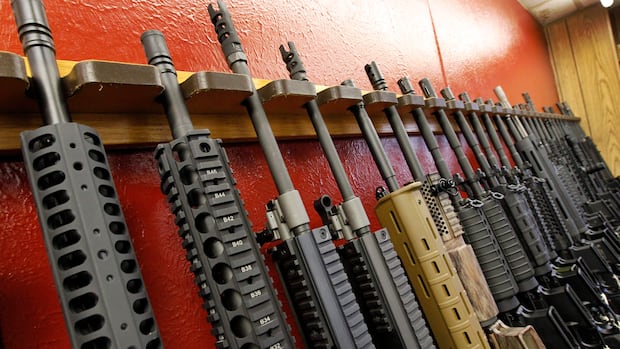
The Brantford Police Service has announced their decision not to partake in the federal government’s gun buyback program involving assault-style firearms. The police service clarified that they will not be involved in collecting or storing firearms as part of this initiative. They emphasized that while the program is administered at the federal level, it is not mandatory for local police services to participate.
Brantford police reiterated their commitment to focusing on essential policing activities such as emergency response, criminal investigations, crime prevention, and victim support services. They highlighted that these priorities are crucial for maintaining community safety and effective law enforcement within the City of Brantford.
The federal government has banned approximately 2,500 makes and models of “assault-style” firearms since 2020, contending that these firearms are designed for military purposes rather than hunting or sport shooting. The Assault-Style Firearm Compensation Program is now offering compensation to individuals who register and surrender their prohibited firearms.
It is important to differentiate between assault-style rifles and assault rifles, with the latter being military-grade, fully automatic firearms like M-16s, AK-47s, and C7s. These firearms are prohibited in Canada. The banned assault-style rifles in Canada include the AR-57, XM-15, and AR-15.
The deadline for Canadians to declare their intention to participate in the buyback program and receive compensation is March 31. Failure to comply before this date may result in criminal liability for possessing prohibited firearms. Compensation payouts will be processed within 45 business days after verifying the surrendered firearm. The program has allocated $248.6 million for compensating around 136,000 outlawed firearms on a first-come, first-served basis.
Some opposition to the buyback program has been voiced by certain gun owners and the Conservative Party of Canada, who argue that the initiative unfairly penalizes law-abiding gun owners without enhancing public safety. Alberta, Saskatchewan, and Yukon have expressed dissent towards the program, with Yukon’s justice minister citing the unique needs of residents in remote areas where assault-style firearms are seen as necessary for protection against wildlife threats like bears.
On the other hand, advocates in support of the program believe it is a crucial step in removing assault firearms from circulation. Ken Price, a representative of Toronto’s Danforth Families for Safe Communities, has expressed support for the program, emphasizing the importance of police cooperation in ensuring gun owners comply with the law.
Overall, the federal government’s gun buyback program is aimed at addressing concerns surrounding the possession and use of assault-style firearms in Canada, with varying perspectives on its effectiveness and implications.