
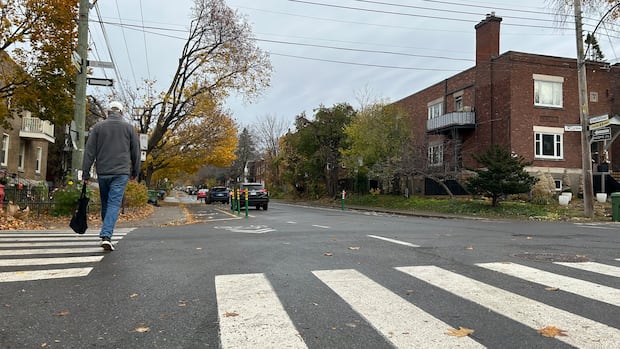
A biking advocacy organization is criticizing the City of Montreal for removing protected bike lanes during the winter months.
On Monday, Masse Critique performed an outdoor “cyclo-drama” theater event outside city hall to highlight the concern.
Raúl Garate from Masse Critique stated that eliminating protected and cleared bike paths in winter endangers cyclists.
“The city seems to believe that by taking away those bike lanes in winter — they do not acknowledge that cyclists are still present in winter and require safety even more during this season,” he remarked.
Garate noted that the removal of these lanes forces cyclists to share road space with trucks, buses, and other drivers, all of whom encounter tougher driving conditions in winter.
Terrebonne bike path affected by winter changes
One of the impacted lanes is a segment of the Terrebonne bike path located in Côte-des-Neiges-Notre-Dame-de-Grâce, which will be closed to accommodate additional parking.
During a recent Montreal city council meeting, borough mayor Stéphanie Valenzuela mentioned that the change affects only one side of the path and lasts just for a few months each year.
Valenzuela described it as a compromise, stating that the administration aims to consider the needs of all road users, residents, and local institutions.
She made this statement while responding to a question from Devyn Vincelli of the Association of Pedestrian and Cyclists of NDG.
When questioned about the hazards for cyclists using the path in winter, who would have to maneuver between parked cars and moving traffic, Valenzuela asserted that making the road one-way had reduced many risks.
She added that the borough has made significant investments in enhancing intersection safety and plans to continue doing so.
Vincelli had directed his inquiries to Montreal Mayor Soraya Martinez Ferrada, but Valenzuela addressed them instead.
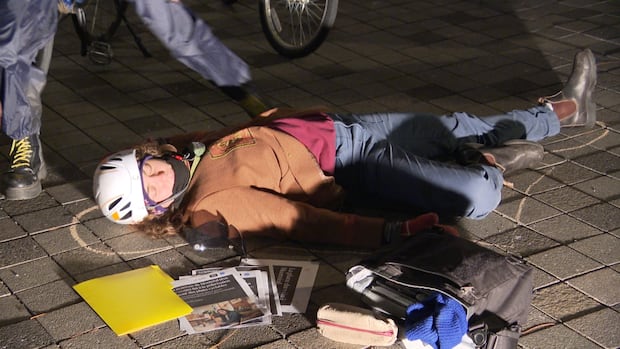
Cycling advocates argue that the decision to temporarily close certain bike paths in Montreal puts lives at risk. This follows the closure of three paths in Ahuntsic-Cartierville and Côte-des-Neiges—Notre-Dame-de-Grâce for the winter.
Seasonal bike lane closures are a borough decision
Additional impacted bike lanes are situated in Ahuntsic-Cartierville and include segments of Park Avenue, Meilleur Street, Port-Royal Street West, Legendre Street West, and Tolhurst Street. These closures will also provide more parking during the winter.
The path on Meilleur Street is one of four paths across four boroughs that the city reviewed due to safety concerns.
Findings from the technical audit released in late October indicated that there was no justification for dismantling the paths based on safety issues.
In response to the audit results, Masse Critique has criticized the city for its silence regarding the announced winter closures.
In a statement to CBC News, Alan De Sousa, an executive committee member overseeing mobility, stated that the choice to remove bike lanes for winter is made at the borough level.
Regarding the audit, De Sousa reiterated during Monday’s council meeting that the findings were preliminary, with a comprehensive report anticipated in January.
While he confirmed that no safety issues were identified, he acknowledged ongoing concerns about coexistence on the roads.
Martinez Ferrada reiterated her desire to resolve the contentious debate surrounding bike lanes versus roadways in Montreal.
“We are an international city — one that promotes mobility for all users, including pedestrians, drivers, and cyclists. Our administration is dedicated to achieving this while considering all users,” she informed reporters before Monday’s council meeting.
She also expressed her intent to provide relief for specific areas, mentioning the Meilleur bike path as an example, where certain sections lack delivery zones for businesses and adapted parking spaces.
Winter closures will increase tensions: Vélo Québec
Jean-François Rheault, the leader of Vélo Québec, emphasized that year-round bike paths are crucial for many who cannot depend on public transport.
He added that trying to satisfy everyone will likely result in greater polarization.
“Removing bike lanes in the winter will not decrease the opposition to them,” he stated.
“In spring, nobody will say, ‘Oh, we are delighted that our parking is gone and the bike paths are back.’ It essentially creates conflict.”
Alongside the safety issues associated with removing dedicated infrastructure, Rheault pointed out that it also incurs significant expenses.
“They must repaint lines, adjust signage, and remove bollards,” he explained, noting that these costs accumulate when repeated frequently.
Meanwhile, as some paths begin to shut down, Masse Critique has vowed to continue advocating for enhanced safety measures for cyclists.