
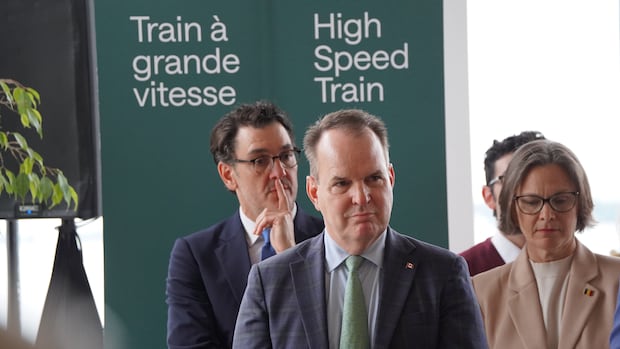
The Liberal administration is contemplating a major alteration for the Alto high-speed rail initiative, which could shift the rail corridor southward towards the shores of Lake Ontario.
This proposed rail line, stretching from Quebec City to Toronto — a project Prime Minister Mark Carney aims to initiate within four years — was revealed late last year, featuring intended stops in Trois-Rivières, Laval, Montreal, Ottawa, and Peterborough.
During a press conference in Kingston on Monday, Transport Minister Steven MacKinnon indicated that the deliberation of an alternative route stemmed from insights gained during Alto’s 100-day public consultation period.
He stated his office is “going to take a very, very, long, strong and positive look” at the possibility of incorporating Kingston into the future plans for Canada’s inaugural high-speed rail line.
-
Mayors of Kingston and South Frontenac unite in support of high-speed rail route
-
Concerns arise over Liberal plans to expedite high-speed rail
-
‘Perhaps make a stop in Kingston’: Ford supports high-speed rail along Hwy 401 corridor
“This project is fundamentally for the common good. It is intended for the people,” he remarked. “It has been designed to assist individuals, communities, and facilitate a more seamless way of living, working, and enjoying life across the corridor, while also drawing visitors.”
MacKinnon mentioned that the consultations with Indigenous communities conducted from October 2025 to June 2026 along the Toronto-Quebec City corridor also played a role in shaping this decision.
Despite some resistance from residents along the proposed path, the mayors of Kingston and the Township of South Frontenac have expressed a favorable stance.
Alto has put forth two routing options. The first is a largely direct line between Peterborough and Ottawa, while the second is a southern alignment that brings it within a half-hour’s drive of downtown Kingston.
In March, the two mayors convened to advocate for a third option that would position the Alto rail line further south — along the Highway 401 corridor — with a stop in Kingston.
“There is considerable opposition to both the northern and southern corridors, and we are encouraging Alto to heed the feedback they are receiving rather than merely pushing through that opposition,” Kingston Mayor Bryan Paterson stated.
“In this scenario, you receive a strong affirmation with a few key conditions that are both technically feasible and make economic sense.”
Regional Via Rail travel as a ‘feeder’ for Alto
Councillors from both Kingston and South Frontenac have already passed separate motions expressing their opposition to the route unless it extends to Kingston with a stop there.
MacKinnon noted that Kingston ranks as the fourth-busiest Via Rail station nationwide, and services from the city could serve as “a feeder” for the high-speed rail system. He emphasized that a Kingston stop would be heavily utilized by students from Queen’s University.
“While it does create a longer route, the additional time is not significant enough to deter individuals from opting for a brief flight, driving, or utilizing alternative travel methods,” he added.
In a previous statement, the minister mentioned that a stop in Kingston would depend on technical feasibility and project requirements.
Ontario Premier Doug Ford has previously endorsed a southern route for Alto along the 401 corridor that includes a Kingston stop.
-
How Alto plans to compensate property owners for its high-speed rail plans
-
Concerns arise over Liberal plans to expedite high-speed rail
The 1,000-kilometer rail line, utilizing fully electric trains capable of reaching speeds of 300 km/h, is anticipated to cost between $60 billion and $90 billion.
Since its announcement, the project has encountered backlash from landowners along the proposed route, who may face land expropriation for construction.
Changes in the Budget 2025 Implementation Act related to the Expropriation Act and other regulations have made it faster and easier for the federal government to secure land for the new railway.
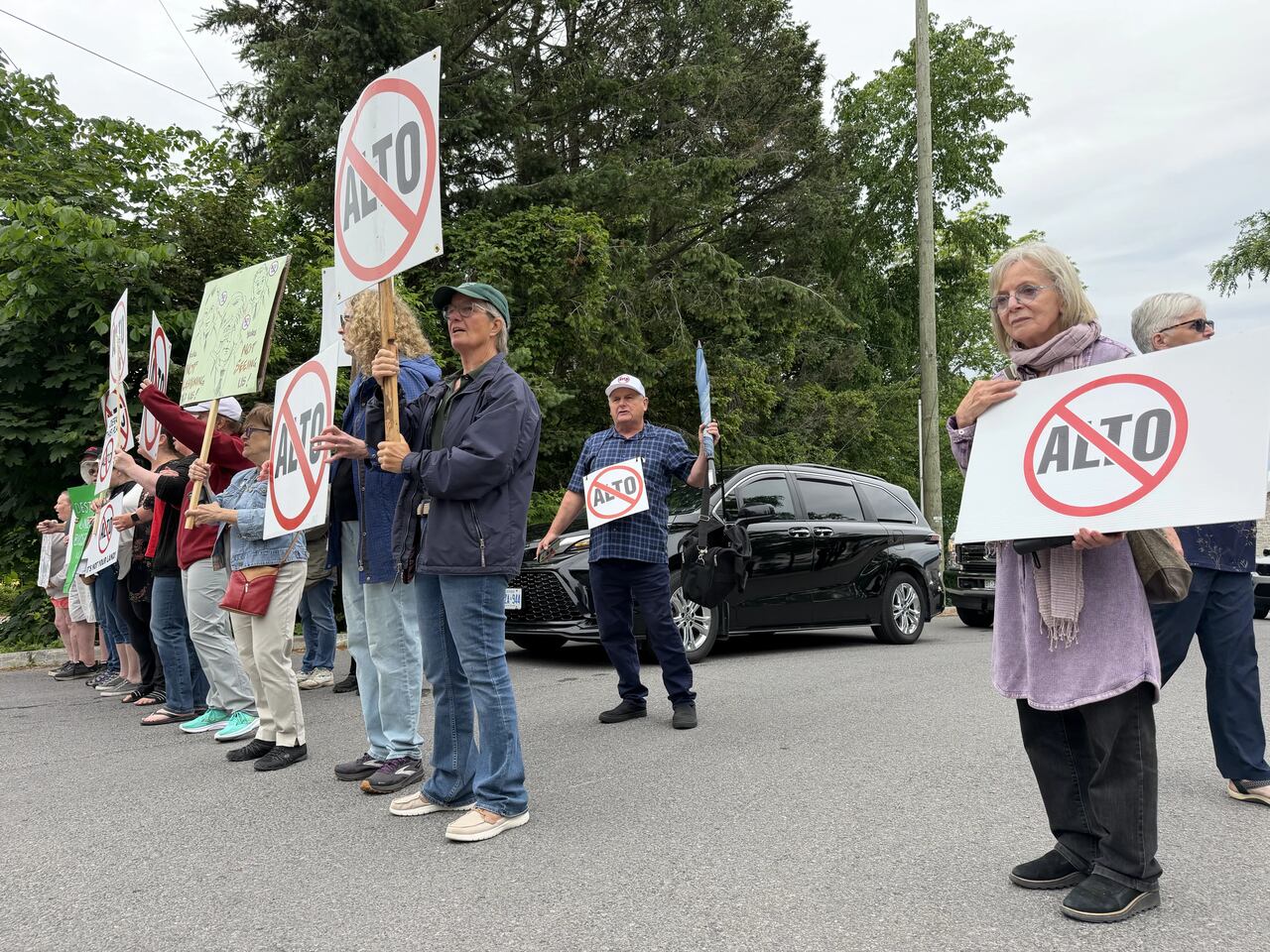
Protesters in Kingston demonstrate their opposition to the federal initiative to construct a high-speed rail line connecting Quebec City and Toronto. The demonstrators obstructed the exit to the Isabel Bader Centre in Kingston during the minister’s announcement, prompting police intervention to clear the area. (Dan Taekema/CBC)
MacKinnon remarked that, coming from a farming background, he comprehends the emotional connection that residents along the route have to their land.
As the specific route begins to be defined, he expressed his preference for a federal right-of-way to traverse the land, though he acknowledged that in certain situations, land will need to be expropriated.
“I have instructed Alto to move forward with utmost sensitivity, and to engage respectfully with landowners affected by this route, which will generally be a 60-meter-wide corridor that must travel in a straight line,” he stated.
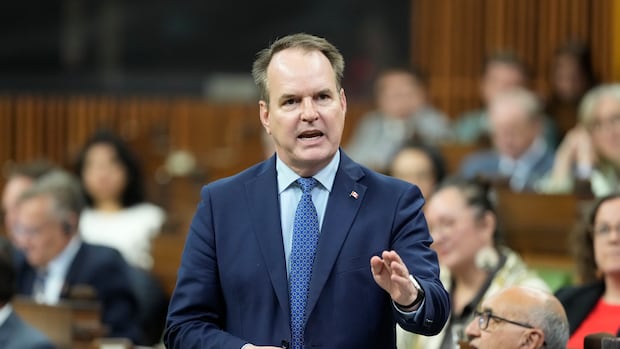
Although Transport Minister Steven MacKinnon stated ‘our obvious preference’ is to obtain land for the Alto high-speed rail project from willing sellers, he added that it may require the government to expropriate property from owners in certain instances.
The minister assured that the project will aim to minimize its impact on properties and the environment along the intended route.
“We will not compromise on respect; we will not compromise on sensitivity,” he affirmed.
Expropriation attorney Shane Rayman has previously informed CBC News that both provincial and federal regulations regarding land expropriation for significant projects, along with their treatment in court, reflect the intent to ensure landowners are compensated fairly for any losses incurred during an expropriation.
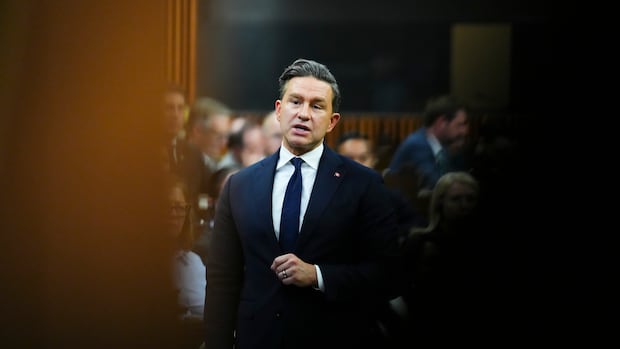
Conservative Leader Pierre Poilievre asserted ‘let’s focus on reducing the cost of living’ while the Liberal government considers a route adjustment for the Alto high-speed rail project that could include Kingston, Ont. ‘Let’s enhance transportation for all Canadians by eliminating the GST on used cars,’ Poilievre stated. ‘This would provide real, tangible savings to real people.’
In Vancouver, Conservative Leader Pierre Poilievre dismissed the notion that Canadians would prefer Alto over traveling by car. He argued that it would be more prudent to allocate funds intended for high-speed rail towards tax reductions, such as the GST on used vehicles sold through dealerships.
“If this project gets realized, it will be 15 years from now and will cost each family an additional $8,000 in taxes,” Poilievre claimed. “It won’t reduce the number of cars on the road, only the number of passengers on planes.”
The Conservative leader has called for the complete cancellation of the project.