
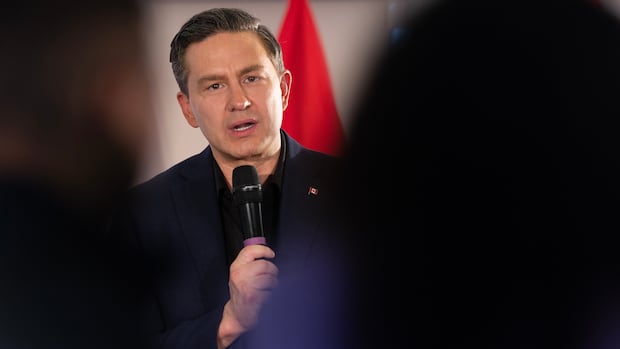
Conservative Leader Pierre Poilievre is criticizing a joint initiative by the federal and British Columbia governments aimed at purchasing unoccupied condo units in the province to convert them into affordable housing, labeling it a “bailout” that should be halted immediately.
During a press briefing in Vancouver on Sunday afternoon, Poilievre questioned, “Where is your bailout?” He contended that Prime Minister Mark Carney appears to have a bailout plan for anyone associated with the Liberal network of influential figures.
On Thursday, Carney, along with B.C. Premier David Eby, revealed that the federal government intends to invest over $5 billion in local infrastructure across British Columbia in the next decade through the Build Communities Strong Fund.
A key aspect of this agreement is the Canada-British Columbia Partnership on Condo Conversion, which aims to utilize “innovative financing tools” to transform more than 2,200 vacant condos into affordable residences.
According to a statement from the Prime Minister’s Office, “this is one of the fastest and most effective methods to boost housing supply — allowing British Columbians to move into affordable homes as swiftly as possible.”
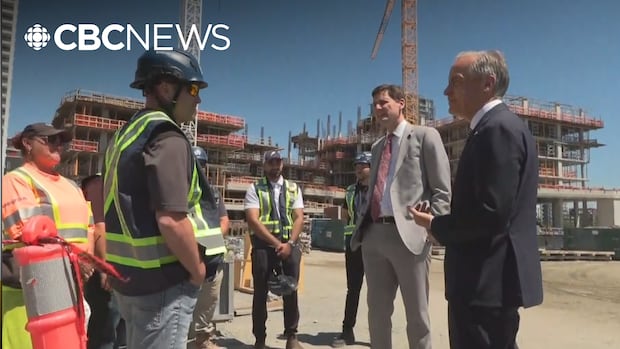
Prime Minister Mark Carney held a press conference in Vancouver alongside B.C. Premier David Eby today, announcing new measures to create affordable housing in the province. As the CBC’s Michelle Ghoussoub reports, it promises to address vacant condos and reduce the charges paid by developers.
This initiative has faced backlash from several housing specialists and provincial parties, including Poilievre, who argue that it effectively serves as a major bailout for developers who are unwilling to reduce prices in response to a stagnant real estate market.
Andy Yan, an urban planner and director of Simon Fraser University’s City Program, expressed skepticism earlier this week, asking, “How much of this is truly aimed at assisting the industry versus being a bailout for poor business decisions made by some of these developers?”
Poilievre asserted that the genuine “innovative financial tool” is merely waiting for the prices to decrease until someone can afford to either buy or rent the condo, emphasizing that developers accepted the risk of constructing properties in a favorable housing market.
“They chose to build those condos during a time when we were experiencing a housing bubble,” Poilievre remarked. “Now they’re trying to sell these homes when the housing bubble has collapsed. Therefore, the risk has not paid off.”
‘No free lunch here’
Poilievre claimed that the prime minister aims to “privatize the profits while socializing the losses. In simpler terms, make you bear the cost…. There’s no free lunch. Someone has to cover the losses.”
Recent statistics from the Canada Mortgage and Housing Corporation indicate that as of last month, there were 4,376 completed condos remaining vacant in Metro Vancouver, marking a 76 percent rise compared to the same time last year.
Carney mentioned on Thursday that the Liberal government intends to apply the “appropriate financial mechanisms” to convert condos that might otherwise remain unoccupied “potentially for another couple of years” into affordable housing.
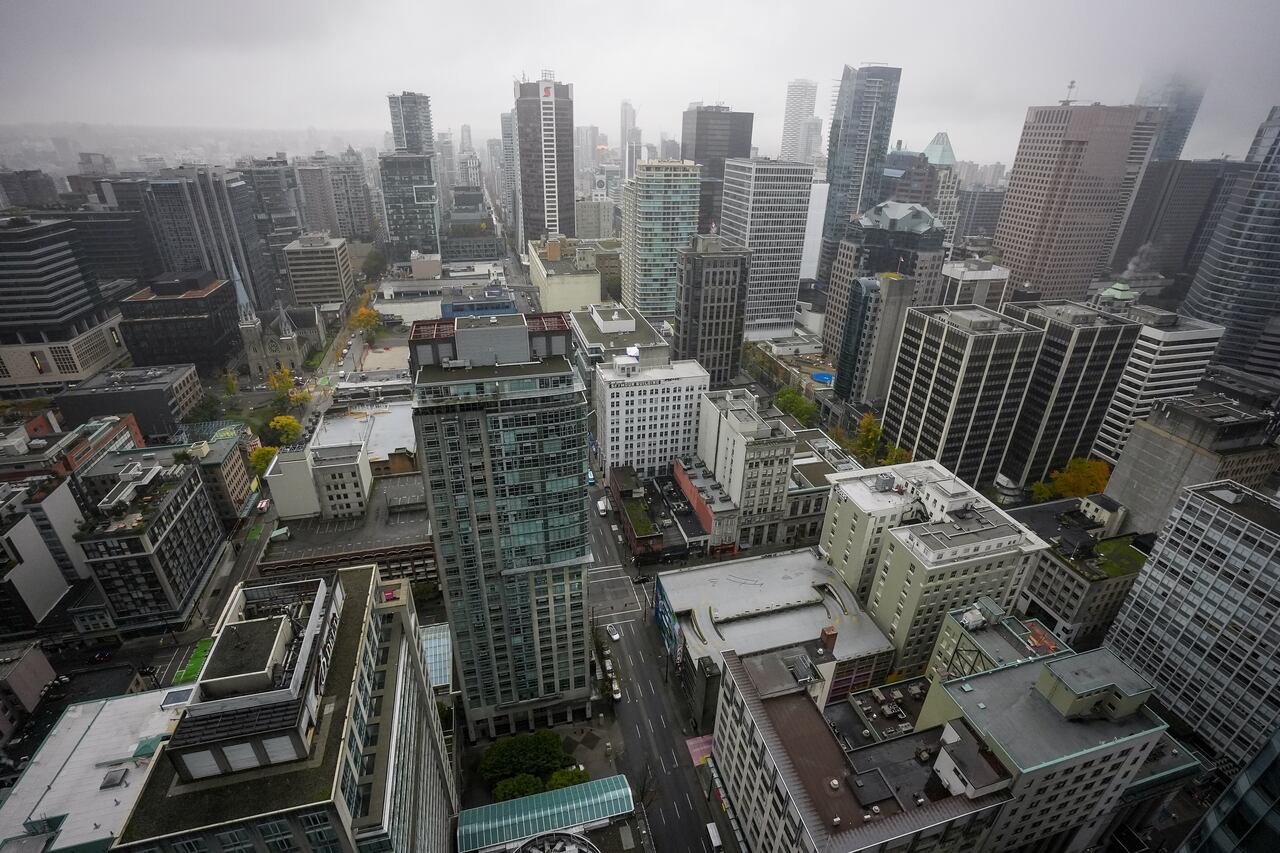
Condo and office towers are seen in downtown Vancouver in October 2025. (Darryl Dyck/The Canadian Press)
The prime minister did not clarify whether the government plans to acquire units in bulk at prices below market value.
Eby stated that the initiative acknowledges that “there is existing housing stock that has already been built, which people would love to move into as their first home, but they simply cannot afford it.”
In addition to calling for the cancellation of the “bailout,” Poilievre emphasized that Canada must reduce bureaucratic hurdles and taxes on housing construction to boost development.
-
CBC Investigates
Consumer vs creditor: B.C. condo court battle to focus on rights of pre-sale purchasers
-
B.C. development association cancels awards, citing ‘worst housing market in decades’
“We aim to make this the quickest location in the world to obtain a permit. We intend to eliminate all federal taxes and incentivize the removal of municipal and provincial taxes on homebuilding,” he stated.
The new federal-B.C. agreement includes funding allocated for the next decade to reduce the fees developers owe to local governments.
Carney explained that by cutting development fees for multi-unit housing by as much as 50 percent, builders could save around $40,000 per unit, while governments would finance infrastructure such as water systems, wastewater systems, and local roads.