

Actress Christina Applegate, 54, is currently looking into the possibility that her breast implants might be connected to her ongoing pain and fatigue, following her recent revelation that she was misdiagnosed with multiple sclerosis (MS) in 2021.
During the November 10 episode of MeSsy, a podcast she co-hosts with fellow actor Jamie-Lynn Sigler, Applegate, who became well-known as a teenager for her role in the popular sitcom Married With Children, mentioned that she recently received a study indicating that symptoms linked to breast implants can mimic those of MS.
“I’ve been thinking for years, ‘What if they’re leaking and making me sick?'” she expressed, stating her intention to discuss this concern with her healthcare providers.
-
As Christina Applegate reveals MS misdiagnosis, doctor warns of wrong treatment risks
-
The subject of Lyme disease is littered with misinformation. Celebrities are part of the problem, experts say
In 2008, Applegate underwent a double mastectomy and breast reconstruction after being diagnosed with an early stage of breast cancer and testing positive for a BRCA1 gene mutation, which increases the risk of developing breast and other cancers. On her podcast, she mentioned that she is “way overdue” for replacing her implants.
She also shared her experiences of increasing pain and trouble with her right shoulder, explaining that it can take her at least ten minutes to sit up and rise from bed. The various symptoms she faces are overwhelming because “there are so many potential issues.”
Her inquiry into these health concerns follows an October update from her doctors stating that she does not have MS. Applegate remarked that this revelation has left her feeling as if she is back at “Square 1,” as her physical difficulties persist and she is undergoing tests for other possible conditions, including rheumatoid arthritis, lupus, and Lyme disease.
As the origin of her symptoms remains unclear, some cases have linked breast implants to health issues, although the specifics of this condition are not well understood.
What is known about breast implant illness
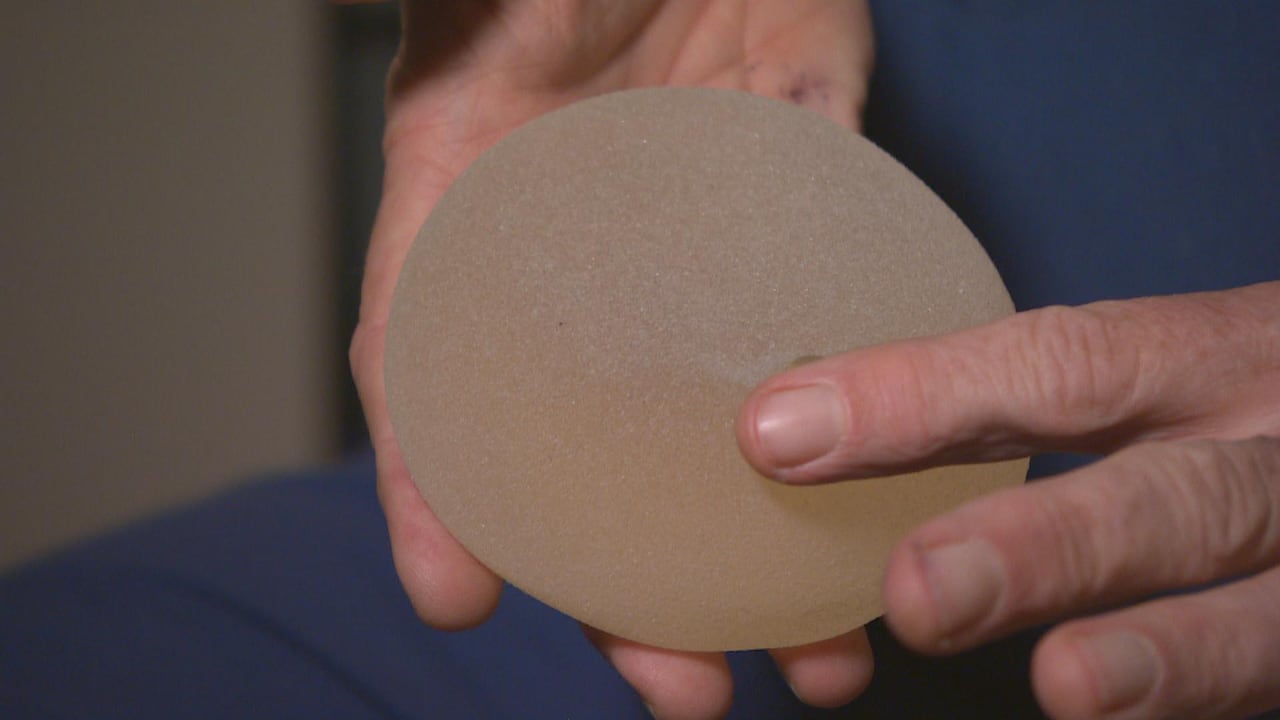
Breast implant illness, or BII, refers to symptoms experienced by some individuals with implants, which may include fatigue, cognitive changes, joint pain, and muscle pain. The image depicts a Biocell textured breast implant by Allergan. (Nicolas Amaya/CBC)
Breast implant illness, often abbreviated as BII, encompasses a range of symptoms reported by certain individuals who have implants.
As of December 31, 2025, Health Canada had documented 663 reports of symptoms or illnesses associated with breast implants — approximately one report for every 1,025 implants sold in Canada.
The most commonly reported symptom was fatigue, followed by mood fluctuations, gastrointestinal issues, and cognitive changes. It is important to note that these are reports and not confirmed cases; Health Canada indicates that the current data does not determine whether the implants caused the symptoms, as other factors may be involved.
The U.S. Food and Drug Administration (FDA) clarifies that BII is not an official medical diagnosis and lacks a specific testing method. Reports of symptoms, such as fatigue and joint discomfort, do not clarify their frequency or establish a causal link to implants.
Julie Elliott, a Canadian advocate for breast implant illness and implant-related cancer with the Breast Implant Safety Alliance, who has experienced health issues following breast augmentation, informed CBC News that some symptoms reported by individuals with implants can overlap with those of MS.
-
National breast implant registry much needed but long overdue, patients and doctors say
-
Alberta women with breast implant illness urge doctors to warn others of risk
“Chronic fatigue, memory issues, concentration problems, numbness, tingling, nerve pain, muscle weakness, and hair loss — these are indeed similar to MS symptoms,” Elliott stated.
However, she advised caution against assuming that Applegate’s implants are the cause of her symptoms. “I’m not suggesting that Christina Applegate’s breast implants are the reason for her issues,” she stated, emphasizing that it would be “premature and irresponsible” to make that assumption.
“Similar symptoms do not automatically equate to the same diagnosis,” Elliott stated. “No potential cause should be dismissed or overlooked without proper medical investigation.”

Christina Applegate, left, attends the 29th Screen Actors Guild Awards in Century City, California, on February 26, 2023. (Valerie Macon/AFP/Getty Images)
Dr. Stephen Nicolaidis, a plastic surgeon based in Montreal, who has treated over 1,500 patients seeking implant removal, also stressed the importance of exploring alternative causes.
He referred to BII as a “diagnosis of exclusion,” indicating that thorough evaluations are necessary, and if no other cause is identified, the possibility that implants might be contributing should be considered.
Commonly reported symptoms he encounters include fatigue, hair loss, skin rashes, respiratory issues, joint and muscle pain, sleep disturbances, and cognitive fog. Some of these can overlap with symptoms linked to autoimmune disorders.
Commenting on Applegate’s reported symptoms, he noted, “The symptoms she is experiencing could indeed be related to her breast implants.” However, the underlying cause of BII remains unidentified, and researchers do not currently have clear answers regarding how implants might contribute to these symptoms.
Nicolaidis explained that there is no specific test for diagnosing BII. While imaging can reveal silicone outside an implant, such findings are not necessary for someone to report their symptoms. He also pointed out that BII is distinct from implant-associated lymphoma, which is a cancer linked to specific textured implants.
Rupture, removal, and next steps
A rupture or leak poses a separate issue from BII. The FDA identifies rupture and deflation as potential complications of implants and recommends that patients discuss any new or unusual breast changes with their healthcare provider.
Likewise, Health Canada advises individuals with implants to regularly check for any unusual breast changes and to communicate any signs or symptoms with their doctor. Decisions regarding the maintenance, replacement, or removal of implants should be made in consultation with a clinician, considering individual symptoms, potential causes, and surgical risks.
The agency does not recommend preventive removal of implants, as surgery carries its own risks, and encourages individuals experiencing symptoms to discuss their concerns with a healthcare provider.
-
Struggling with pain for years, N.S. woman heads to Montreal for breast implant removal
-
Video
The costly, complex and dangerous world of removing medical devices | The Implant Files
Nicolaidis recommends that individuals with symptoms seek a comprehensive medical assessment. He stated that if other causes are not identified, they should explore whether their implants might be contributing to their issues and discuss available options with their healthcare providers.
He ceased placing breast implants in 2021, believing that the potential risks often outweighed the benefits, and now primarily focuses on implant removal. He noted that removal does not guarantee a cure; some patients he treated for MS only reported slight improvement, and those with a diagnosed autoimmune condition may still require ongoing medical treatment after undergoing explant surgery.
Elliott emphasized that symptoms related to implants should be taken seriously, while recognizing that their underlying causes are not completely understood. She encouraged patients to seek well-rounded, evidence-based information and to keep track of any changes in their health.
“The absence of complete answers does not mean that women’s experiences should be dismissed,” she concluded.