
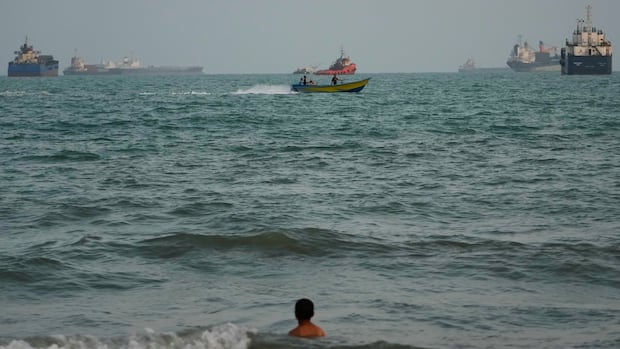
The newly appointed leader of Iran’s Supreme National Security Council announced on Sunday that Tehran intends to declare an “exclusion zone” beyond the Strait of Hormuz, targeting vessels it suspects of attempting to navigate through the waterway.
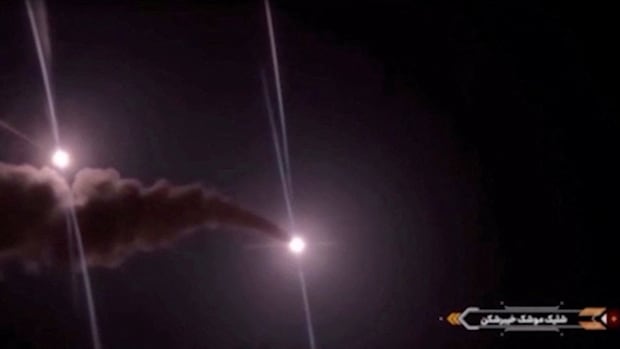
Mohsen Rezaei shared these remarks with Iran’s state broadcaster, providing limited specifics, just a day after the U.S. military struck three Iranian oil tankers in retaliation for Iran’s ballistic missile attacks against U.S. warships. Analysts described the missile launches as a significant escalation following Iran’s earlier assaults on commercial shipping.
Rezaei stated that the forthcoming exclusion zone would be revealed in the upcoming days and weeks, stating it “will commence from the line of the U.S. naval blockade, stretch toward the Strait of Hormuz, and continue into the Persian Gulf from this side.” He added, “Any vessel entering this area with the intent of passing through the Strait of Hormuz will be identified and added to our sanctions list.”
It remains unclear where Iran delineates the boundaries of the U.S. blockade, which has been in effect for weeks and aims to restrict Iranian ports from exporting oil. According to the U.S. military, over 20 warships are involved in supporting the blockade, which had redirected 92 commercial vessels and disabled three by Sunday.
The U.S. has been implementing new strategies to amplify economic pressure on Iran following the breakdown of negotiations, with no resolution to the sporadic conflict appearing imminent.
Iran alleges attack on U.S. ship, which is denied by the U.S.
In the meantime, Iran continues to target vessels attempting to traverse the Strait, leveraging it strategically in the ongoing conflict that erupted over six months ago with strikes from the U.S. and Israel.
On Sunday, Iran claimed to have hit an unmanned U.S. vessel attempting to enter the Strait of Hormuz, a statement that the U.S. military branded as a “complete fabrication.”
This incident marks the latest exchange in the ongoing hostilities between the two nations.
The alleged attack followed a day after the U.S. military reported that its forces had targeted three Iranian oil tankers in response to a missile strike against its naval vessels.
The conflict commenced with assaults by the U.S. and Israel on Iran on February 28. However, despite a ceasefire agreement announced in June, sporadic fighting has continued, with both parties inflicting military and economic damage as negotiations have faltered.
Later on Sunday, after a weekend filled with attacks, counterattacks, and threats exchanged between the U.S. and Iran, Canada’s Foreign Affairs Minister Anita Anand issued a statement condemning Iran’s “destabilizing actions.”
Anand noted, “Canada is collaborating closely with partners, including within the G7, to maintain substantial pressure on Iran.”
Attacks resume about a week after hostilities reignited
Last week, the U.S. and Iran resumed their attacks after a month of relative tranquility, with the Strait of Hormuz and nearby Iranian communities once again becoming targets. Earlier in the week, at least five individuals were killed during a U.S. airstrike on southern Iran.
It appears the Trump administration has adopted a dual strategy in the conflict, responding militarily to assaults on the strait while targeting foreign financial institutions linked to Iran’s finances.
Nevertheless, Iran’s new hardline leadership has indicated a readiness to endure after surviving decades of sanctions.
-
U.S. military hits 3 Iranian oil tankers after saying its navy warships were targeted
-
Iran attacks U.S. bases across Gulf after reports of deadly strike on wedding
Over the years, Iran has developed methods to bypass sanctions — and now the U.S. blockade — to deliver its oil to buyers, helping to alleviate mounting economic challenges. This includes relying on a shadow fleet for oil transport.
Simultaneously, Iran’s nuclear program, which contributed to the war’s outbreak, was intended to be resolved through negotiations that unraveled shortly after the U.S. and Iran signed a memorandum of understanding in mid-June.
Diplomats indicate that the U.S., along with Britain, France, and Germany, plans to refer Iran to the United Nations Security Council for not adhering to its nuclear non-proliferation obligations.
Instead, Tehran’s current leverage is centered on the Strait of Hormuz, critical for global oil and natural gas shipments, which was regarded as an international waterway prior to the onset of the conflict.
Regarding the failed negotiations with the U.S., Rezaei expressed skepticism not only towards the U.S. but also the mediators involved. The memorandum of understanding signed in mid-June quickly unraveled as both sides accused one another of breaches.
“We had placed our trust in our friends in Pakistan, Qatar, or Oman, believing that their role as mediators would include preventing violations of the agreement,” Rezaei stated. “We are now seeking diplomacy backed by guarantees.”
U.S. estimates 9 million barrels a day transit through the strait
The Strait of Hormuz holds immense significance for global oil and natural gas transit and was classified as an international waterway prior to the conflict.
On Sunday, U.S. Energy Secretary Chris Wright remarked that, on average, nine million barrels of oil are flowing through the strait daily, which should ease pressures on energy prices.
This estimate seems to surpass the average volumes recorded over the past 28 days through the strait, according to TankerTrackers.com and other sources.
Wright informed CNN that with oil also being transported through regional pipelines, “we’re probably at two-thirds or more of pre-conflict levels.”
However, these flows rely on the presence of the U.S. navy to escort tankers and offer protection against potential Iranian attacks. Wright expressed confidence that other nations would ultimately support the navy’s initiatives.
Simultaneously, during his interview with state television, Rezaei asserted, “Every day, we are selling one million to one and a half million [barrels], demonstrating that Iran’s oil production and trade are proceeding as usual.”